A Dog in a Subway

Featured

Two nights ago, I walked into a sub shop to buy dinner for my daughter.  There was a man with a dog.  He was about my age and the two boys with him were likely his sons. The dog was a dog – I don’t know if it was a purebred or a mutt.  I do know that it was on a leash and had a collar and a nice temperament.  What it didn’t have was anything that indicated that it was a service dog or a seeing eye dog.  It was clearly the family pet.  In a restaurant.  With food being prepared just a couple feet away, and multiple tables for customers.

I almost shook with anger.

I wrote last week about my ‘bad wolf’ and my propensity to get angry at strangers who offend my sense of right and wrong.

I was very offended by dog man.  I craved confrontation.  Not physical.  But I wanted to call him out on offensive, inconsiderate, selfish behaviour.  It’s a restaurant.  For people. Not dogs.

For the last several years I’ve taken an intense interest in what’s often referred to as ‘personal growth,’ ‘self-improvement,’ or ‘wellness.’  I’ve put those terms in quotes for many reasons, including, the billion-dollar industry that lies behind them.  Books and podcasts abound – thousands of them – offering philosophies, lists, and tips on how to ‘be your best self.’    The self-help industry is easily, and perhaps justly mocked.  But it exists because we are all imperfect, fallible creatures with the capacity to recognize our shortcomings.

I didn’t shake with anger, but I seethed with rage.  My instinct was to tell dog man his dog shouldn’t be in the restaurant and he should leave.  His boys were teens, or nearly so, and clearly capable of ordering their food and paying for it.  I wanted to tell dog man to take his dog outside.

I considered a passive aggressive approach.  There were three employees behind the counter.  I could have asked, loudly, “are dogs allowed in here?”

I didn’t say or do anything.  I just stood, waiting my turn in line.  Dog man went to the washroom, taking his dog with him.  Weird.

I just wanted a shredded cheese, cucumber and mayo sub for my daughter.  I didn’t want a confrontation.  I didn’t say anything.

But my inner outrage soared.  What if my daughter was with me?  Ever since our dog died, she’s battled a fear of dogs.  Had she been with me, and this dog approached her, she might have been terrified.  Maybe she would have screamed.  Maybe she would have hidden behind me in fear. 

However, she wasn’t with me.  That wasn’t happening.  The staff didn’t seem at all bothered by the dog.  Hard at work, not one of them seemed to care.

Dog man returned from the washroom.  He and the dog hovered near his boys.  He asked them if they’d ordered for him.  They had.

The boys were quiet.  Polite with the staff.  Unaware of the angry middle-aged man standing behind them.  The first reason I didn’t say anything to dog man was because of those boys.  I did not want to embarrass dog man in front of his sons.  I did not want to subject them to an uncomfortable, awkward, potentially volatile situation.  Like my daughter, those boys just wanted subs for dinner.  They wanted an uneventful, quiet, family night.

I recognized this as a moment to test myself.  It would feel good, in the moment, in the split second, to confront dog man.  To tell him he was wrong. 

But was he wrong?  Maybe not.  I stood there and considered that maybe he wasn’t doing anything wrong at all.  If this was France, no one would bat an eye.  Maybe I wasn’t mad at him, but at our ever-changing world.  When I was a kid people didn’t bring dogs into businesses, or restaurants.  Full stop.  It wasn’t a thing.  At least in Ontario.  But I’ve lived on Vancouver Island for close to twenty years now.  I’ve seen dogs inside businesses dozens of times.  People do that here.  Maybe they do it everywhere now.

Maybe it wasn’t unhygienic.  A plastic shield protected the food.  The dog was just inches off the ground.  I was way more likely to get sick from a staff member or customer coughing and sneezing. 

Did it matter if he was wrong or I was wrong?  This was an opportunity.  An opportunity for me to pause, breathe, and not react based on my initial thoughts and feelings.  A small and easy opportunity to calm my bad wolf.  A small step on the road to living a life where my actions aren’t dictated by what others do and how that makes me feel.

Sometimes that is necessary.  I have intervened when the actions of strangers are clearly wrong.  Several years ago, my wife, daughter and I, were walking in downtown Victoria enjoying a beautiful spring day.  A man sprinted out the door of a convenience store.  A woman followed, yelling for him to stop.  I asked what happened.  She replied he’d stolen a can of soda.  I followed him, yelled at him to stop, and that I was going to call the police.  He stopped, turned around, put the soda on the ground, and took off again.  I returned the can of Coke to its rightful owner. More recently, I was in the check-out out counter at a grocery store.  My daughter was with me.  An irate customer started screaming at the employee at the customer service desk.  He was horrible, insulting her personally, loudly, and using vile language.  A manger asked him to leave.  He didn’t.  I strode over, stared him down, and, very loudly, told him to leave and to “do it now.”  He left.

Looking back on the soda stealer, and the man in the grocery store, I’d do the same things again.  Especially grocery store guy.  His words and actions were disgusting.  I’m glad I intervened.  I think that was my good wolf at work.

I thought about those things as dog man and his boys waited for their subs.  I kept my mouth shut.  My order was done before theirs.  I paid my bill and walked out.  I reminded myself that you never know what is going on in someone’s life.  Just because dog man’s dog wasn’t a service dog doesn’t mean that the dog wasn’t providing comfort and security that I didn’t understand – comfort and security that dog man needed in his life at that moment in time.

Or maybe dog man was just a selfish, self-centered, entitled idiot who never once considered that strangers in a restaurant didn’t want to be around his dog.

Ultimately it doesn’t matter.  My instinct was to say or do something.  I’m glad that I didn’t.  One of the reasons is that the dozens of books I’ve read, and hundreds of podcasts I’ve listened to over the last few years, have encouraged self-reflection and a desire for self-improvement that was absent for much of my life.  The wisdom of others has given me practical tools that, when I use them, can make a difference.  I wish I’d had those tools a long time ago.  I’m thankful I have them now.

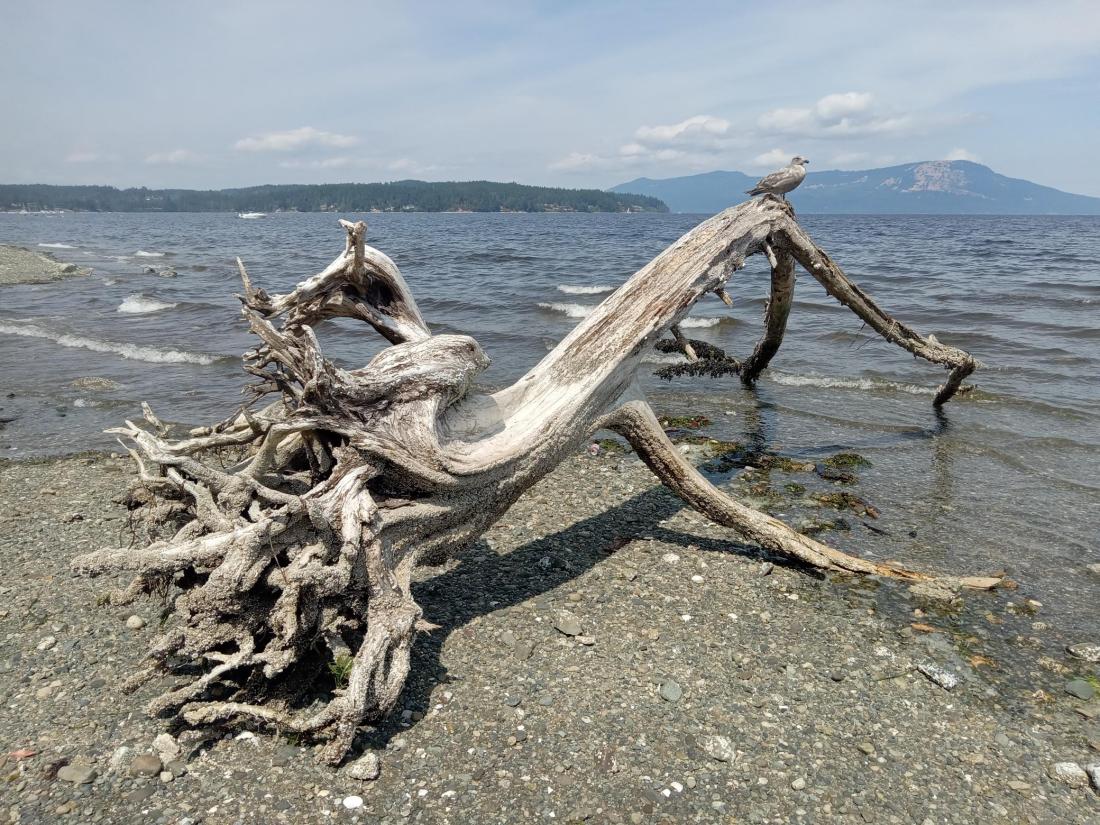
… Postscript. The accompanying photo is from a walk on the beach with my daughter.  While we live a long walk, and short drive from the water, we don’t get there often.  I’m always thankful when we do.  … Among the most influential authors and podcasters in my life are Dan Harris (10% Happier), Rich Roll (the Rich Roll Podcast), Dr. Rangan Chatterjee (Feel Better, Live More) and Eric Zimmer (the One You Feed). 
The One You Feed

World War II dominates my reading life.  Max Hastings’ sweeping history of the war ‘All Hell Let Loose’ is seven-hundred pages of horror.  Unimaginable suffering for untold millions, brought to life by Hastings with tiny heartbreaking details.  My fascination with the war deepens my gratefulness for the soldiers, sailors and airmen who sacrificed their lives for a just and noble cause.  I don’t know if any of us can truly appreciate the scale of global calamity.  Millions of non-combatants – fathers and mothers, sons and daughters, friends and neighbours – perished, their last breaths often taken in terror and agony.  Those who survived the war, veterans and civilians alike, often buried their suffering deep inside themselves.  The tentacles of their trauma extended deep into their post-war lives, and the generations that followed.  And yet, despite so much individual suffering, collectively they built a better world.

A recent podcast on the Potsdam Conference, the meeting between Churchill, Stalin and Truman which took place in the shattered suburbs of Berlin after Germany surrendered and as Hiroshima loomed, led me to revisit David McCoullough’s incredible biography ‘Truman.’  I first read it over thirty years ago, and the abiding lesson I drew from it was that a good man could be a great man.  Until a few days ago I hadn’t really considered that President Truman and the current U.S. president shared most of a surname – T. R. U. M.  Harry Truman was an honourable, moral man, who made difficult decisions which shaped the post-war world.  Those of us who grew up in peace and prosperity owe much to him, and his fellow Americans who, thrust into a war they did not want, emerged from it committed to playing a leading role in trying to secure a lasting peace.  The current U.S.  president is the antithesis of Harry S. Truman.  Neither good man, nor great man, he is a stain on the legacy of the high office which he holds.  Despite his vile nature and chaotic tenure, the office, not the occupant, still deserve our respect because one day it may again be occupied by a good person who is also a great person. 

Being good is hard work.  McCullough quotes a young Truman writing to his future wife Bess: “[I am] just a common everyday man whose instincts are to be ornery, who’s anxious to be right.”  One of my favourite podcasts is called, ‘The One You Feed.’  It’s premise, based on a parable, is that there are two wolves inside us all – a good wolf, and a bad wolf.  A grandson asks his grandfather which wolf wins.  The grandfather responds, “the one you feed.”  My good wolf and bad wolf battle daily.  My bad wolf screams at my daughter, when stress and frustration boil over.  My bad wolf feasts on anger which lives within me, never far from the surface and all too willing to make an appearance, especially when a stranger offends my sense of right and wrong.  Just over a week ago my bad wolf unleashed a verbal tirade on a cyclist riding on a sidewalk while my family walked beside me.  My bad wolf chooses immediate pleasure over long term health.  When unleashed, it gorges on junk food.  Once I start, I’m incapable of moderation. 

Reading helps feed my good wolf.  David Brooks’ ‘The Road to Character,’ is beside me as I write this – each chapter an examination of the life of an imperfect person who worked to better themselves.  As Brooks writes in the introduction, “I wrote this book not sure I could follow the road to character, but I wanted at least to know what the road looks like and how other people have trodden it.”  I fill my journal with quotes from books laying around the house, or posts from social media – wisdom from secular Buddhists, Stoics, C.S. Lewis, and endurance athletes.  I feel instinctively that every word I absorb, and then rewrite, brings me a little closer to universal truths. One of those universal truths is that my bad wolf is just as much a part of me as my good wolf.  I can observe my bad wolf without judging it.  Ultimately, taming my worst instincts means trying to understand my bad wolf and showing it love, compassion, and understanding. 

Reading, writing and running help tame my wolf and cleanse my soul.  Reading means absorbing the experiences and wisdom of others.  Reading about the war puts my own problems and stresses into perspective.  Reading lifts me.  A beautifully written passage in any book is a work of art that becomes part of me.  If reading is a process of absorbing, then writing and running are processes of expending.  I’m a private person, usually reluctant to share details of my life with people I don’t know well, yet I pour inner thoughts and feelings onto the page and publish them.  And it feels right.  Running always feels right, even when it hurts.  Sometimes especially when it hurts.  Years ago, when I was going through a difficult time, I ran until it hurt, and my inner voice repeated a mantra over and over, “burn away the hurt, burn away the pain.”  In those circumstances I sought pain to erase pain.  But that was, and is, very rare.  Running, day by day, month by month, year by year, has been like a purge valve that imperceptibly lets out noxious fumes that I might not even know are present.  A little over a year ago I retired from policing after twenty-four years.  I was blessed to retire with physical health and mental health.  I owe much of that to running.  Thousands of plodding miles where my body and brain processed what I had seen or done at work and left the poisonous byproducts behind on roads and trails.

Running.  Good for the soul.  Not always for the body.  Every day I do an inventory of what hurts most.  My right heel almost always wins, but my left heel and right knee are occasionally contenders.  Somehow, my right elbow has now joined the fray.  Still, I plod on with the goal of not plodding.  I’ve set an aggressive but realistic time goal for this fall’s Royal Victoria Marathon.  Which has meant weekly speed sessions at a track for the first time in well over a decade.  Running fast for short distances sucks.  Legs and lungs burn.  In the hours before I leave for the track my bad wolf whispers, “take this week off.  You’re busy.  You’re tired.  You can skip a workout.”  But I’ve made it every week so far.  At the track, during the sessions my bad wolf screams, “slow down!  Less hard means less hurt.”  I listen and try not to obey.  To run hard and fast, I must force my bad wolf to run with me. 

What a privilege it is to run.  To read.  To write.  To do battle with a wolf and not an enemy soldier.  To grow up in a world shaped by imperfect men and women who did their best.  To draw on the examples they set about how to live good lives and shape a better world.  To know that good and right can triumph over evil and injustice.

Postscript

Having not written in some time this piece was an exercise in returning to fundamentals.  Reading.  Writing.  Running.  A recent photograph from my phone usually accompanies each essay, as is the case today, with a photo I accidently took several nights ago.  I hadn’t seen it until just now.  I’m not sure what it is or how I took it.  Maybe it was a fortunate mistake, with bright light shining over darkness.

The Thin Line of the Living

Featured

Genealogy consumes my early morning hours.  When the house is still asleep, and with a cup of coffee beside me, I pore over a blossoming family tree, searching for answers I may never find. 

This near obsession started months ago, soon after reading All the Light We Cannot See, a beautiful and painful novel about a French girl, and a young German soldier whose lives intersect briefly, but intensely, near the end of the Second World War. 

I thought of my mom, born in the Netherlands, in October 1944. A horrific winter of starvation and deprivation awaited the Dutch people.  Thousands would die.  One of the deaths was an infant – my mom’s twin sister who only survived a few weeks and lost her life on November 11th 1944.  Remembrance Day.

I imagine the grief and misery my grandparents must have endured as young parents in a war torn, Nazi occupied nation.  I knew those grandparents well and spent a lot of time with them growing up.  I occasionally asked them about the war, but they spoke little about it.  I know almost nothing about what they endured.

The desire to know more, a lot more, led me to genealogy.  My father’s family was also a mystery.  The surname had changed sometime in the early 20th century when a Polish family adopted a British sounding name.  I’ve learned my dad’s grandparents moved from Poland to the United States before World War I.  They had children, and then, inexplicably moved back to Poland.  Somewhere in those years one son died, and another was born.  The family made its way back to Canada in the 1920s.  They were not wealthy.  I don’t know how, or why, they emigrated to North America, returned to Europe, and then came back again.

My wife’s family is German and Scottish.  Our daughter carries these bloodlines within her.  My research increasingly draws me to the wars and the intersections of our families. My wife’s grandfather was wounded in the Great War.  My wife’s uncle, Helmut, still a teenager when he enlisted, criss-crossed the continent during World War II, fighting on both the eastern and western fronts.  He was wounded in France, just weeks after D-Day, fighting to rappel the Allies who fought to liberate the continent – liberate people like my pregnant grandmother and her soon to be born twins.  Throughout the war, Helmut took photos, and he bequeathed the remarkable album he produced to my father-in-law.  I’ve spent hours examining that album and followed the journey of this young German paratrooper, who both wandered the streets of occupied Paris as if he were a tourist and not a soldier, and suffered unimaginably on the frozen Russian front in March 1942, in temperatures of -35 Celsius.  A year later he was transferred to the Netherlands, where he was stationed an hour’s drive away from my grandparents’ small town.  They almost certainly never met, or even saw one another, yet through my daughter, they are connected.

It is easy to build a family tree given all the resources available online.  It’s much harder to reconstruct a life.  I find photos, and newspaper clippings, but those do not add up to a life.  Gravestones tell me when a person was born, and when they died, but tell me nothing about the life they lived.

Every morning when I open my family tree, I am humbled by, and thankful for those who came before me. I am grateful to have been born in Canada, after the wars and in a time of prosperity where health care is widely available.  My tree, and likely yours too, is filled with children and adults who died young, very young, throughout the 19th and early 20th centuries.  My great-grandmother passed away giving birth in her home, in a working-class Ontario city, in 1929.  She was only 38-years old.  The son she bore died that night too.  I think of the legacy that those deaths must have had on that family. 

My foray into genealogy has reminded me that no person or group has a monopoly on suffering.  It is a part of the human condition. 

Above all, delving into the past, reminds me of the importance of the present moment, and reinforces for me that nothing matters more than the love and well-being of our families and those we love.

Light Pokes Through

Featured

November rain didn’t fall on Vancouver Island this year.  At least, not as often as it usually does.

Instead, our days have been cold and clear. 

The nearby trails have been icy instead of muddy.

I’ve needed sunglasses more than a rain jacket.

Those trails have been a lifeline over the last few months.  Our family has experienced two significant health challenges.  In both cases, the worst may be behind us, however, the stress has been significant and ever present.  And it continues.

At the best of times, November darkness and gloom weighs me down.  This November was not the best of times. 

The sunshine couldn’t have come at a better time.

But the days are short, and the sun is low – very low – in the sky.  And that has affected my runs.

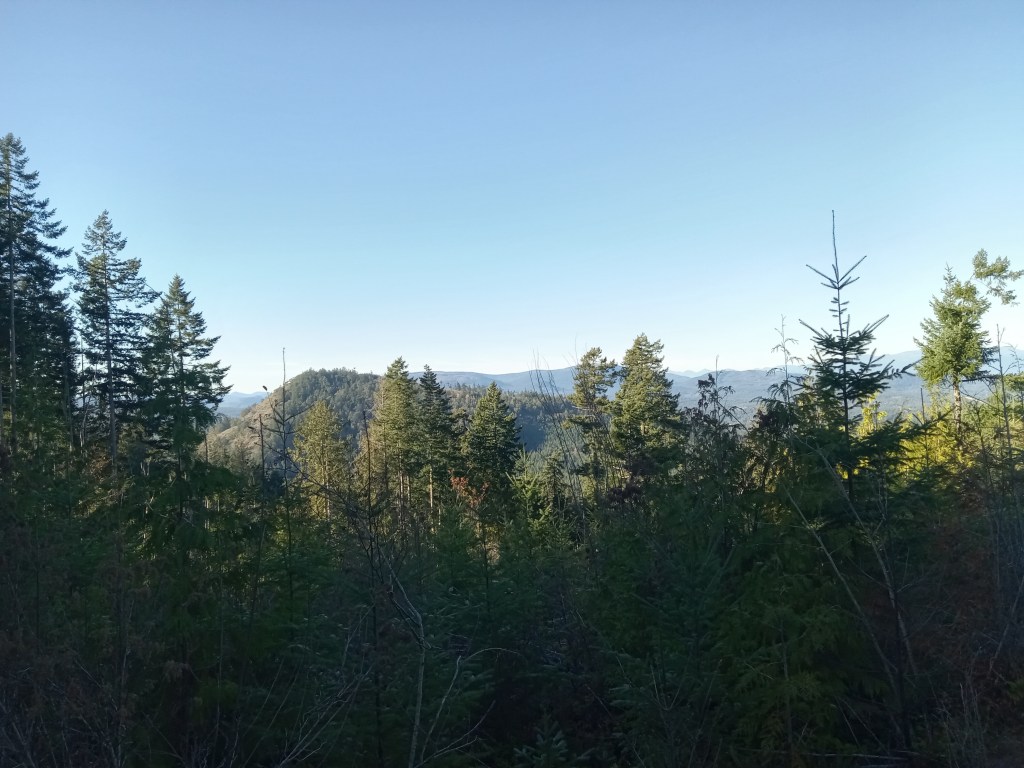
I’ve been exploring near our home.  Trails I have never gone down before. Heights I’ve never reached.  Views I’ve never seen.

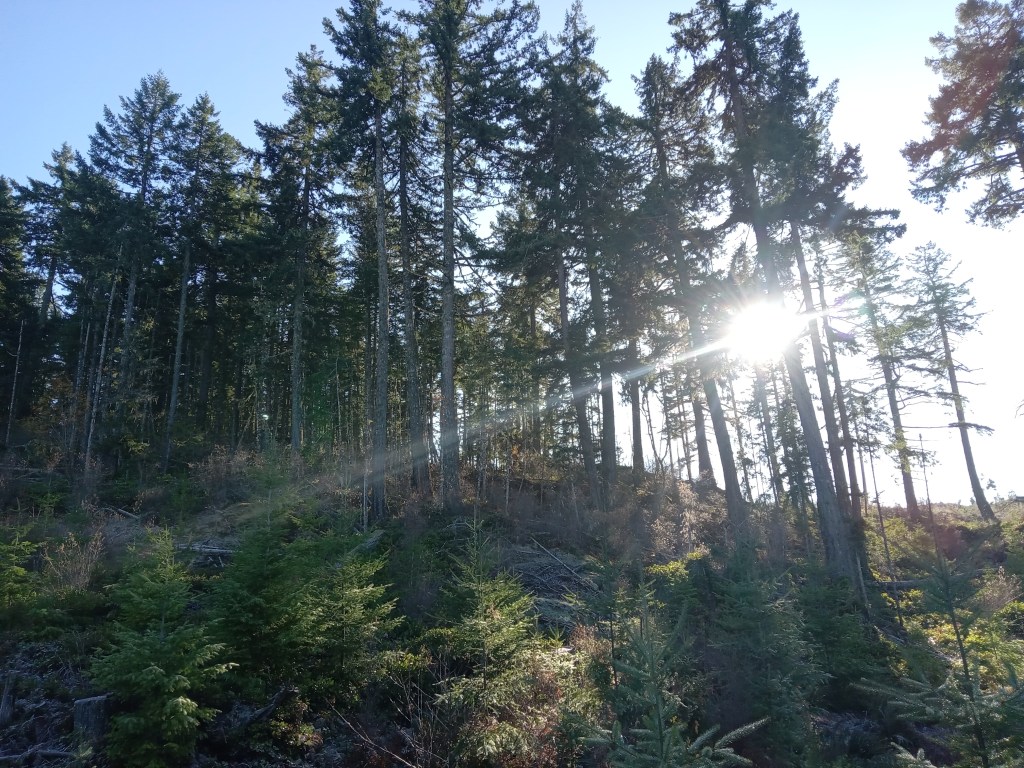
So often, over the last few weeks, I’ve turned a corner and found sunshine streaming through canopies of green.  Shade surrounds me, yet the light streams through, and, behind it, the sky is as blue as the air is cold.

The light that makes it through is indescribable and special.  It’s ethereal.  Almost holy.

It stops me in my tracks.  I breathe it in. 

And I stop running, pull my beat-up old phone out of my running vest, and take photos which don’t do justice to the beauty of what I’m experiencing.

As is so often the case, I’m writing this on a Sunday morning.  One floor down, my daughter plays her electronic piano and sings ‘The Twelve Days of Christmas.’  I’ve never heard her do that before.  Her singing is more precious to me than the light streaming through the trees.  More precious than anything.

The rain was late but it’s here now.  An ‘atmospheric river’ hammering the island.  The sun won’t be shining through the trees today.

Maybe that’s a good thing.  If it happened every day, it wouldn’t be special.  It wouldn’t be magical.  It wouldn’t remind me that light pokes through.

The People Around Me

Featured

Midway through the last long weekend of the summer, our neighbourhood was still and quiet.  People were camping and travelling – the last flurry of activity before school started.  I was also still and quiet which allowed me to hear sounds hidden in the background – birds, a neighbour tinkering, a dog barking.  Nothing moved except trees and bushes swaying in a gentle breeze.  The air was warm even though it was early evening.  I sat on our front porch, hidden from view behind lush leaves and pink flowers.  My wife sat beside me, a glass of wine in her hand.  

Our home is usually a cacophony of sound – often emanating from, and around, our daughter.  She is rarely still or silent and her presence envelops my wife and I in her world.  But that Saturday night she stayed with her grandparents and her aunt.  The timing was good.  I love her more than anything in the world.  Even so, she drained me that day – physically and mentally, and my dad battery ran low.

Two days have passed, and now it’s Labour Day.  The unofficial last day of summer feels like the unofficial first day of fall.  I’m back on the front porch.  There’s no warmth in the air.  Grey clouds hide blue sky.  It’s not quite as quiet.  Kids have returned to the park across the street.  Distant traffic is louder.  A pink pick-up truck I’ve never seen before just drove by our home.  There’s gloominess in the day, or in me, or in both. 

We all grow up returning to school in early September.  It’s familiar and comforting.  I live it now through my daughter’s eyes and her emotions – an amalgam of nervousness, fear and excitement.  My little girl, who once weighed less than four pounds and spent her first few weeks in an incubator in an intensive care unit is about to start Grade 2.  It’s a mix of emotions for me too.  Gratefulness for her sheer existence.  Wonder and awe as I watch this little person grow and develop and change every single day.  Thankfulness that she is still young and naïve and plays with dolls and loves mermaids.  Concern for her gentle soul as she grows up in a world where not everyone is fundamentally kind, or inherently decent.  I remind myself that most people are good most of the time.

Many of those good people live in our neighbourhood.  Kindness abounds and is often centered around our daughter.  We returned from a walk this morning to find a bag of cookies on our doorstep, made for her by a thoughtful woman who is a masterful baker and gracious person.  We were returning from that walk because we’d borrowed ‘Skye,’ a little terrier whose owners allow us to walk their dog, to help my daughter overcome a fear of dogs.  Our living room now has a miniature dollhouse thanks to another neighbour who needed to find a home for his 98-year-old mother’s family heirloom.  That this man thought of my daughter and reached out to us so she would have that dollhouse meant the world to me.  Several weeks ago, our family “camped,” when a good friend parked his 40-foot motorhome in our driveway for the weekend.  His generosity made for sheer joy for my girl who is desperate to camp, and saddled with parents who are not desperate to camp.  Roasting marshmallows in our driveway was as special to her as a trip to Disney. 

This morning I contemplated leaving our neighbourhood.   After we’d walked the dog and found the cookies, I hopped in my car to drive by a house for sale.  It’s not far away. Ten minutes maximum.  But the home is on a steep hill, in a subdivision built on a dramatic incline.  The subdivision has beautiful homes, many with ocean views.  The home I drove by is newer than ours.  It’s bigger.  It’s near a pathway that leads to the ocean.  I miss living a short walk from the ocean.  I tell myself that I should “want less” and I know there is much truth and wisdom to those two words.  Yet, I’d like to live in a home that’s a little bigger, with a yard that is a little smaller, and needs less care. 

I wrestle with what’s the right thing to do.  What’s the right thing to want – or not want.  When I drive in that area, when I walk in that area, it does not feel like a neighbourhood.  It feels like a collection of houses that happen to be in the same location.  The steepness of the streets make it so much less walkable than where we live now.  And walkability breeds contact and conversation – kindness and friendship.    

There is so much value in taming our desires and being grateful for those things we have.  I would miss this neighbourhood so much if we ever left it.  I do feel drawn to the ocean.  It has always had an almost mystical allure for me.  But if we moved to be closer to the Pacific, I would leave behind the trails, hills, and mountains which are so close to me now.  I can run from my home, and, in less than five minutes, be totally alone in nature.  That is another gift which our neighbourhood gives me, every single day. 

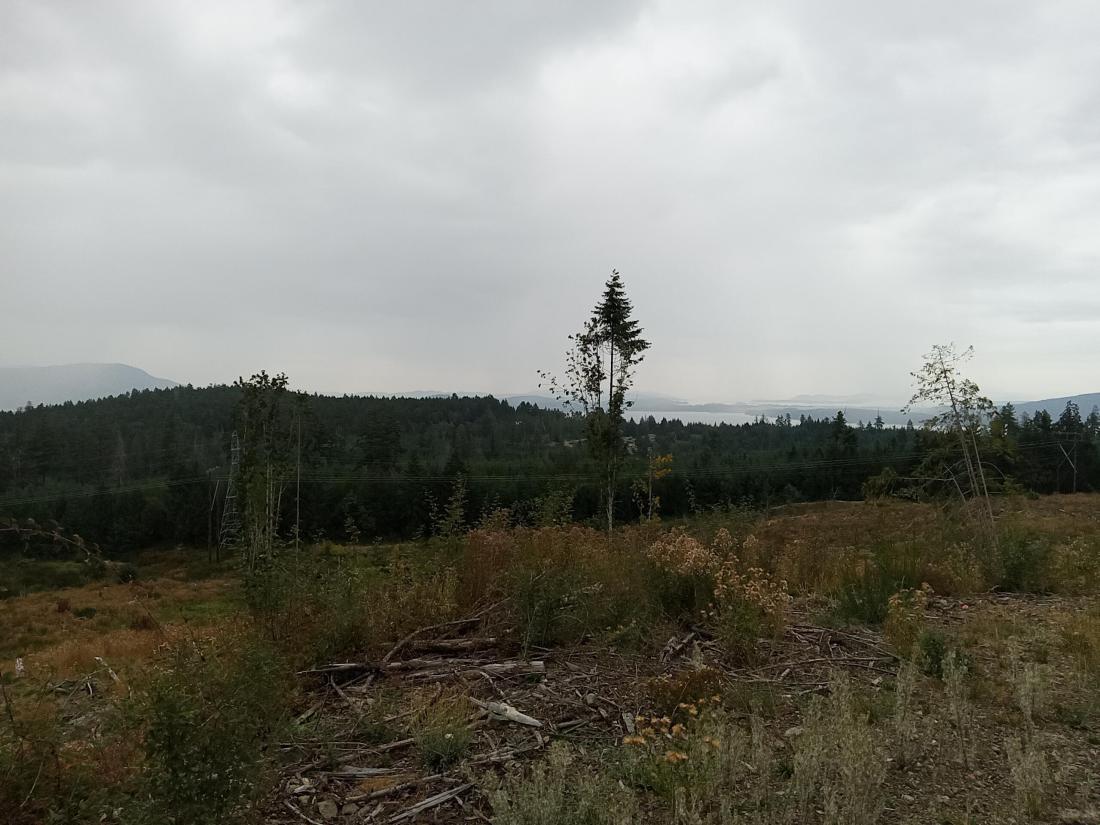
Yesterday, I hopped on my bike and escaped high up in the forest.  I rode, and hiked, and found myself alone, and elevated, surrounded by acres of trees, with a spectacular view of mountains and the ocean.  Maybe that’s all the ocean I need.

It’s still Labour Day.  It’s still gloomy. And I’m still on the front porch.  I hear a basketball bouncing.  I see children riding their bikes.  I know school lunches are being made, and backpacks being packed.  And I’m thankful for where I live and the people around me.

I Did Not Run

Featured

After a couple weeks of constant heel pain, I stopped running and vowed to take a week off.

That was last Sunday. 

My heel is no better.  But I might run anyway.

Strangely, I don’t miss running. At least not the act or sensation of it. I’m not pining for the trails.  I’m not desperate to run long and slow, or short and fast.

But something doesn’t feel right.  Inside me.  I’ve felt it all day.  Call it depression, melancholy, ‘the blues.’  I’m not myself.  Not today.

I’m not sure why.  Usually a “weighted hike” helps.  So I tried that.  I put a dumbbell in a backpack and set off through the forest.  I ate fresh blackberries, sat beside a stream, and watched a fly land on a perfect green leaf. 

A weighted hike usually does the trick.  The dumbbell gets harder and harder to carry.  The shoulder straps dig into my skin.  I lean forward, seeking a posture where everything hurts a little bit less.  At the end of a weighted hike I’m in physical pain. But I feel better.  On the inside.  Nature, solitude, and decompression lift me up from within.

That didn’t happen today.  Today I got home and still felt blah.

I’m not sure why.  It could be because there is nothing I have to do today. The lawn doesn’t need cutting.  My daughter does not need to be dropped off at a birthday party.  My wife and I don’t have to go shopping.  No distractions to distract me from whatever I’m feeling inside.

Maybe it’s shift work.  Two long days followed by two long nights.  Four days of sleep deprivation and a messed up body clock.  The aftereffects carry into my days off.  I feel jetlagged.  I feel hung over.  I feel short tempered. On my first day off, I am mindful of how I speak to my wife and daughter because my fuse is short and my patience is thin. 

Today is my second day off.  I slept long and well.  I’m weary but not exhausted.  I’m well on the way to the feeling of “normal” that usually returns by my third day off.

Maybe it’s the work other people do.  My job title is Watch Commander.  I supervise approximately twenty-five uniformed police officers.  I sit behind a desk, while they are on the street, doing the real work of policing.  I hear it all over the radio.  Assaults, thefts, domestic disputes, overdoses, and a seemingly endless stream of mental health calls.  There are so many broken people, and the police officers I work with spend large parts of their days trying to help.  They work hard, and virtually everything they do is because something bad has happened.  Earlier this week a senior citizen was the victim of an unprovoked violent attack.  Her injuries are life altering.  The cops I work with arrested the offender and went with the victim to the hospital.  It happened at 7:00 o’clock at night, in a nice part of the city, on a beautiful summer’s evening. 

Maybe it’s the work I do.  Like a contentious situation which I could have handled better.  Or sensitive information which gets shared with me because of my position.  Or decisions which I make that affect the professional lives, and personal well-being of the police officers on my shift.  Men and women I’ve come to care about deeply since I started working with them earlier this year.

Or maybe it’s because I haven’t been running.  I biked this week.  I went to the gym.  I stayed active.  But I did not run.

It seems too coincidental that I would feel run down after a week of not doing something I usually do almost every day.

It’s funny, because last Sunday, when I decided to take a break, I was out on the trails in behind our home, and I wasn’t loving the run.  My heel hurt, and my motivation was practically nil.  I’d entertained trying a two-hour run, and knew I didn’t have it in me.  I just didn’t want it.  Which was unusual, because often I look forward to two-hours as the perfect amount of time to be out there on my feet – to challenge myself without overtaxing my system. 

So last Sunday, when I decided to take a break from running, I felt kind of proud of myself.  I felt like I was listening to my body and my mind and it was the perfect time for a break.  A week for my heel to heal and my running mojo to recharge.

And now six days later, I feel the opposite.  A reminder that running for me is about so much more than physical health.  And it’s not just central to my identity.  The blah I feel today is a reminder that running is essential to my  well-being.  Physical tiredness and work stress are nothing new.  They are essential elements of policing.  Nothing about this past week was fundamentally different than the last 23 years of my career.

Except it was one of the few weeks in which I did not run.  And today I’m paying the price.

Impermanence

Featured

My fiftieth birthday recedes daily, but it’s never far from my mind.  If I live to be one hundred, then less than half my life remains. 

I am impermanent, and the recognition of this impermanence colours my life.

I’m declining.  Physically and mentally.  Science, physics, and Arthur Brooks say so.  In his book. From Strength to Strength, Brooks writes abut how our mental and physical capacities inevitably fade with time.  However, Brooks, describes how the back half of our lives – the older years, can be filled with happiness and deep purpose, because the older we get, the better poised we are to serve others by mentoring and teaching, and as he writes, “to face decline – and even death – with courage and confidence.”  [From Strength to Strength (arthurbrooks.com)]

Brooks writes about Buddha.  Over the last year, I have become increasingly drawn to Buddhism, not as a religion, but as a system of thinking and way of being.  Impermanence is at the heart of Buddhist philosophy.  Both Buddha and Brooks caution us to be wary of attachment to things, be they cars or careers, because all things are fleeting.

I’ve attached myself to reading, writing, and running.  I’ve defined myself in those terms, whether naming this website, or describing myself on the dating app in which I met my wife.

All three are at the core of my life, yet I could lose any one of them, at any time.  Accident or injury make all three tenuous.  One bad fall on a steep trail could crack my skull and rob me of reading, writing, and running.  I can’t imagine life without them.

Actually, I can.  We’ve been travelling this last week.  Eight nights in Ontario, visiting family and friends. 

Over the last week, I have not been a Reader, Writer, or Runner.  Instead, I have been an Eater, Drinker, and Driver.

I let go of my attachment to clean eating and gorged on fried food and ice cream.  I felt ill every time I did it.  And did it over and over again.

I drank more over two nights than I have in the last six months.  Gin and tonic, beer and wine, rye and coke.  I drank only in part because I enjoy those tastes and flavours.  I drank to let go. I drank to decompress.  I drank for the buzz.  I drank to enjoy a night with friends.  A night I didn’t want to end.  An evening later, and many miles away, I drank because my wife and I played ‘Name that Tune’ in a bar along a canal in the small town where I grew up.  I drank there because it was fun, and I drank there to release my inhibitions, so I would get up and dance to earn extra points for our team.  I drank because, a night of drinking the night before created momentum and it was easier to say yes to drinking because I’d said yes the night before.

I drove a lot in Ontario, mostly on the busy streets of Brampton, an endless processions of red lights, and constant gridlock.  Two days of driving in Brampton, contributed to more than two strong drinks in Guelph, a picturesque city just outside the orbit of Toronto area traffic.  I relished the drive to Guelph, through small towns and the countryside.  We stopped in Rockwood, at a gazebo beside a river.  We visit this park every year because it is lovely, and water flows alongside it. 

The following day, on our way to the Niagara Region, we sat in traffic for what felt like forever, when an unseen accident, or the sheer volume of cars, ground the Queen Elizabeth Way to a halt.  After more than five decades of life, most of them living in Ontario, and hundreds of trips on ‘the Q.E.W,’ it was my first trip on that highway since the Queen’s death.  We finally escaped bumper to bumper traffic when an exit ramp led to fried food and ice cream, and an extreme hit of salt and sugar.  Junk food momentum had attained peak velocity.  My stomach still hurts.

Impermanence comes in handy when it comes to eating, drinking, and driving.  I know that when we get back to Vancouver Island, my meals will be fresh, my drinks will be ice water, and it will take me a month of commuting to encounter as many red lights as I did during a week in Ontario.

Impermanence will remain on my mind.  One of the best sports writers in the world is Joe Posnanski.  A few days ago, he did not write about baseball or athletes, and instead about his now adult daughter, and how they went to a Taylor Swift concert together, and how Swift’s music had been the soundtrack of his daughter’s life, since she was a little girl.  And while he loves his adult daughter more than anything, he misses his little girl. [Taylor-Made – by Joe Posnanski – JoeBlogs (substack.com)]

Every second of this trip I was conscious of the preciousness of having a young daughter.  A special seven-year-old who crammed a year’s worth of fun, adventure, and tears into a single week.  She shopped at a thrift store with her grandma and bought a five-dollar porcelain doll which she immediately treasured.  Two days later that doll’s head was crushed by a reclining car seat.  I saw her face the moment it happened.  Pure distilled sadness.  An ocean of tears.  Tears that halted when our good friend, who also saw it happen, entered her home, and returned with another porcelain doll.  One that had belonged to her mother.  A doll that was decades old – a Barbara Ann Scott figure skating doll.  A family heirloom passed from our friend’s family to ours.  Barbara Ann is on the plane with us now.  Likely her first time flying, en route to her new home in British Columbia.

I saw a lot of tears this week.  My daughter was disconsolate when she had to say goodbye to her aunt.  An aunt with whom she’d camped overnight for the first time ever in a Port Colborne backyard with a campfire, marshmallows and no mom and dad. 

More tears flowed at The Mandarin restaurant when a straw and some Coca Cola dislodged a loose tooth.  Blood streamed from her mouth.  Not a lot, but enough to scare her.  Mom took care of that quickly.  Then I joked with her about how blood gushed from her mouth and people fled the restaurant in terror.

A few days later, in Niagara Falls, the Maze of Mirrors, induced real terror.  Mom and Dad missed the clue in the title – MAZE!  We thought we were entering a fun house where mirrors would shrink us, expand us, and make us laugh.  Instead, it was an almost impossible to escape building, where mirrors made it appear as if we were everywhere all at once.  My daughter shrieked and cried.  We latched onto another dad and his little boy who were maze veterans and we exited on their coattails. 

Laughter and fun overshadowed tears. My daughter went on the Ghoster Coaster at Canada’s Wonderland.  She was scared, and she did it twice.  It was her first roller coaster ride ever and I was proud.  She played Pac Man for the first time.  She swam in the hotel pool.  The three of us jumped together at a trampoline park – the closest thing I got to a workout all week long.  She hugged everyone over and over.  She ate almost as much ice cream as I did.  She said she wanted to move to Ontario.  She didn’t want to leave her family behind.

All impermanent.  She’s growing up, just like Joe Posnanski’s daughter.  And the laughter and tears of this past week are already in the past.

We will land in a few hours and life will return to normal. Our home, our meals, our routines.  I’ll be at work in a few days and my stress will return.  My wife will return to her own more than full time job – managing the operation of our home and family.  Her stress will return.  My daughter will resume summer vacation, which as an adult, in retrospective, seems idyllic to me, but as a dad, I know will mean more moments of stress and tears for my little girl.

Every moment with my family and friends in Ontario was special.  I miss my parents, and my brother and his wife and children.  I miss them desperately and I miss them year-round.  I entered this trip drained after a few months of nightshifts, and the stresses of a new job. 

I finish this trip with a healthier soul, infused by family and friendship. 

I finish this trip knowing I will return to reading, writing, and running.  Despite their impermanence.

The Broken Bridge

Featured

We can look backwards in time.

Every time you gaze at the stars you are inside a time machine.

The light you see took years – anywhere between four and four thousand – to reach your eyes.

A star that you can see tonight may have exploded thousands of years ago, and no longer exists.  It is gone.  But you can see it.

Intelligent, highly educated people spend their lives studying these things.  Quantum physics.  String theory.  If you Google, “why there is no such thing as touch,” you’ll learn (but like me, perhaps not understand) that there is no such thing.  I thought I was sitting on the couch writing this.  Not quite.  Instead, “when you plop down into a chair or slink into your bed, the electrons within your body are repelling the electrons that make up the chair.  You are hovering above it by an unfathomably small distance.”

At the subatomic level, a particle can exist in two places at the same time.  A measurable thing that exists can be in more than one place at once.

Does any of it matter for any of us?  Arguably not.  Whether we know, or do not know these things, hardly effects our lives.

I do not think about them every day.  I rarely think about them at all.

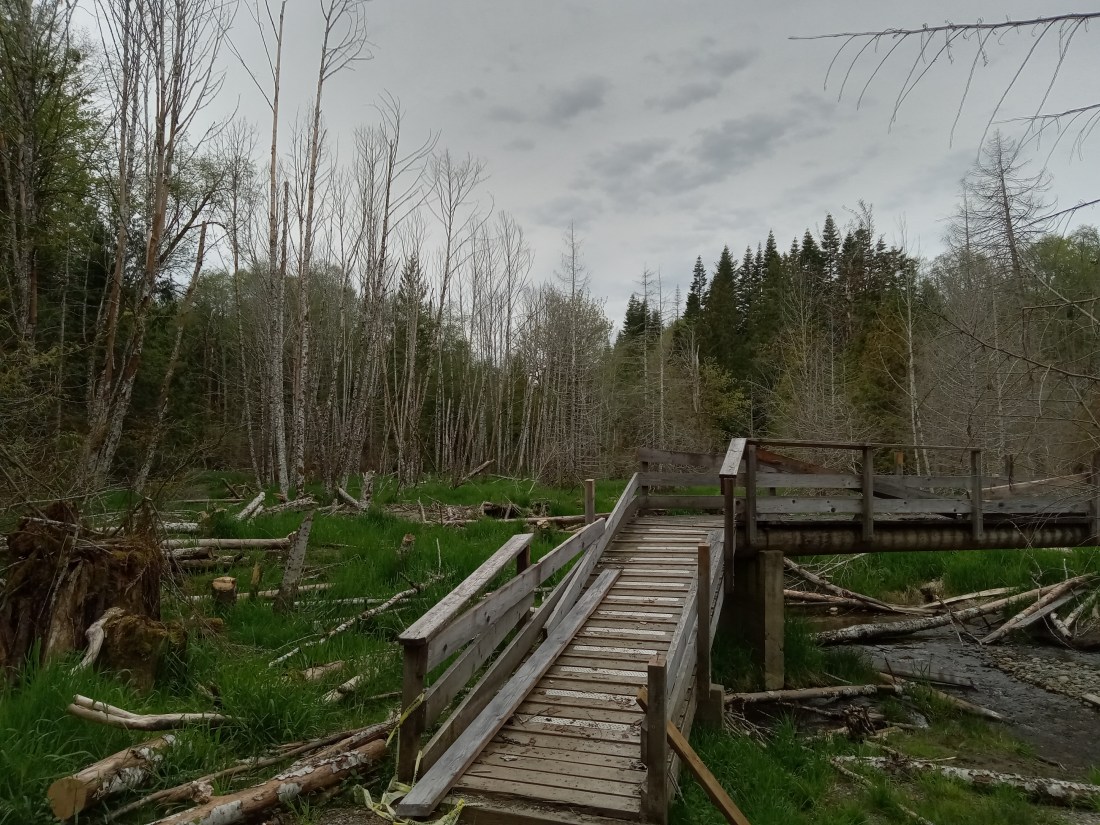
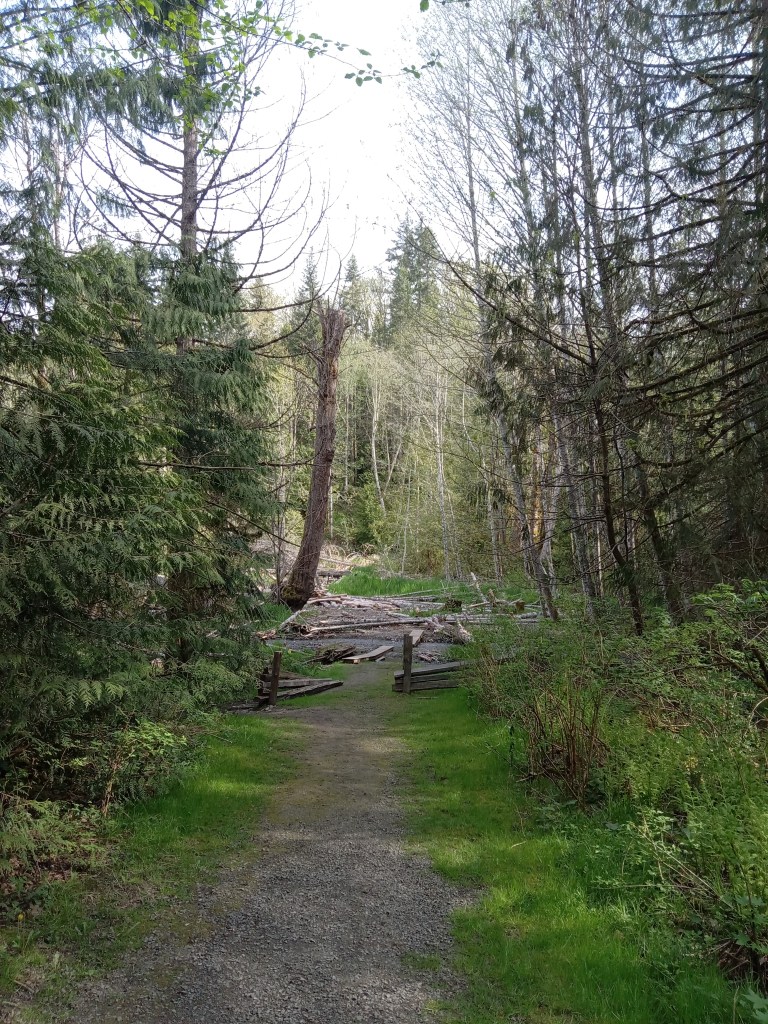
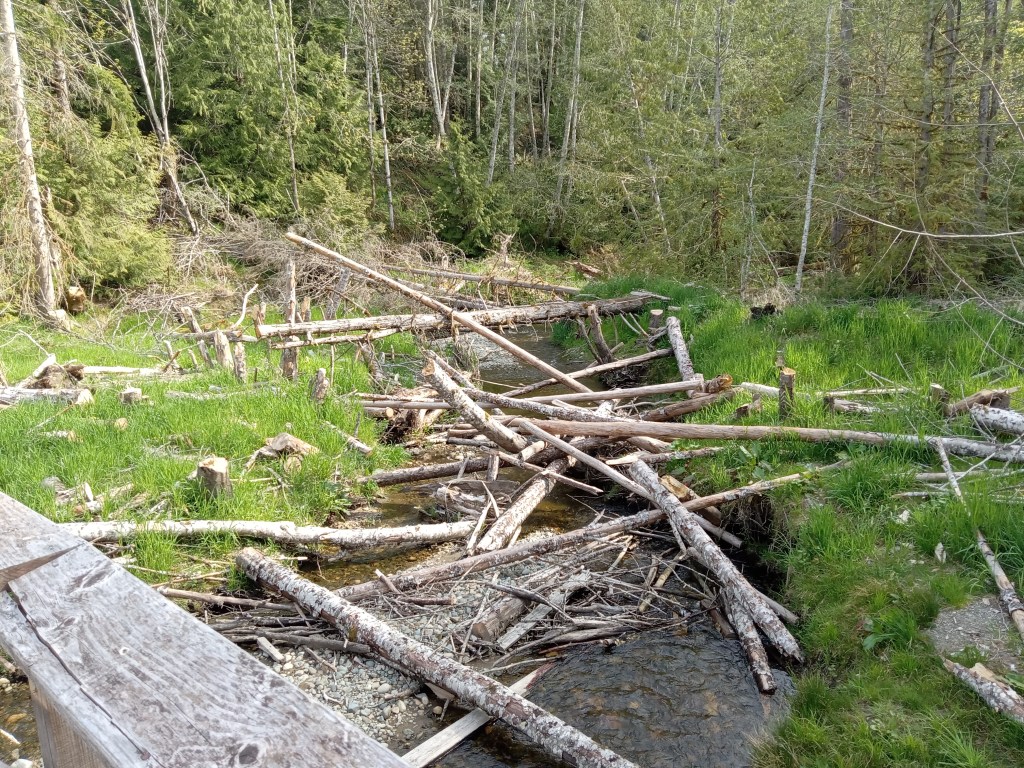
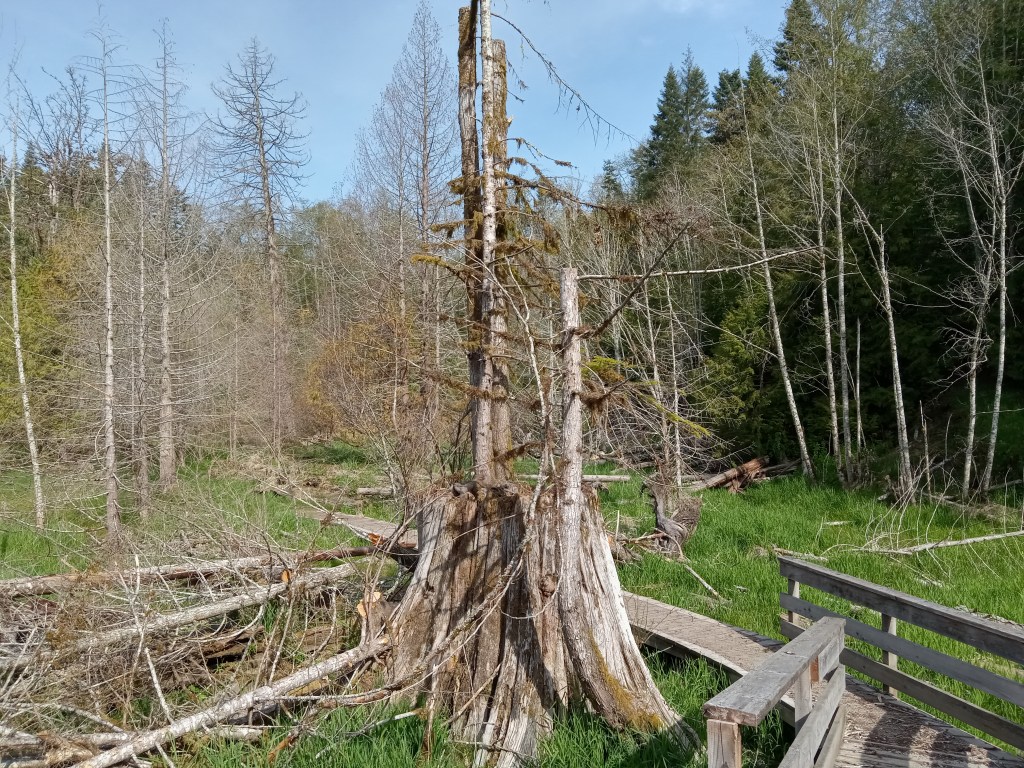
Why did I think about them today?  Because I was straining for an analogy to help explain the unexplainable.  There is a broken bridge near my home.  Surrounding it are forests, and streams, pathways and fallen trees.  This little clearing in the woods is alive with birds and bugs.  I’ve never seen a bear there, but every time I go, I expect to.  It feels like exactly where a bear should live.  I am drawn to this place. 

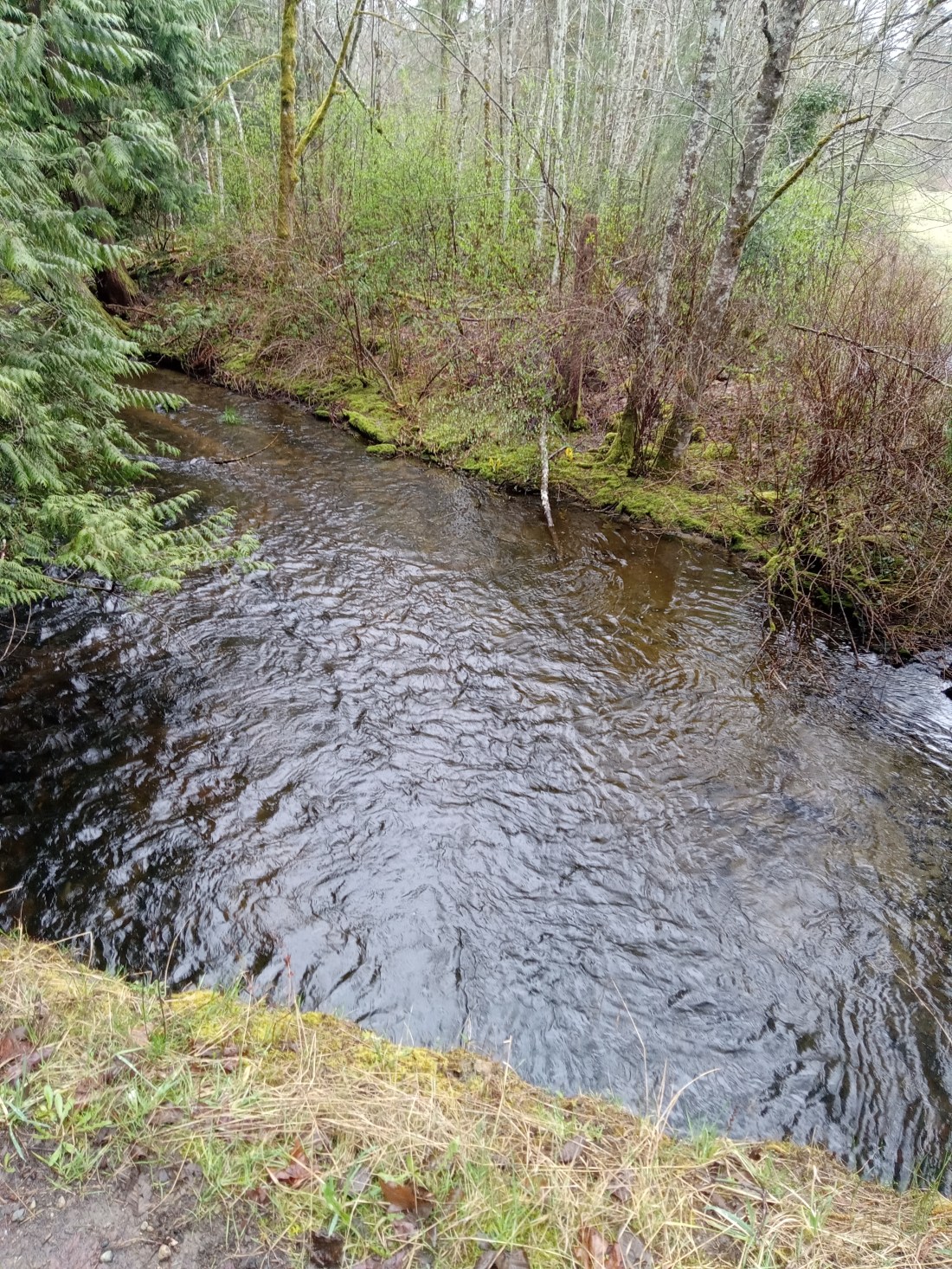
In a subatomic world, where I can be in two places at one time, a part of me would always be at the broken bridge.  It exudes peace.  Sometimes I stand on the bridge and hear the water that runs below.  Sometimes, I sit on a log and just listen.  I’ve meditated there.  I’ve walked beyond the bridge and discovered a trail I did not know existed.  The broken bridge is the place where my inner voice yells the loudest, and the broken bridge helps give me the resolve to listen to it.  The broken bridge is the place that I limped to last week, when an old hip injury flared up, and I worried that, not only would I be unable to complete the Vancouver Marathon, but that weeks or months of pain loomed ahead. [I finished the marathon.  And my hip still aches].

When I walked there last week – “layered” is the word that stuck in my head.  The broken bridge and the world around it are layered.  Vibrant greens contrasting with dull greys and browns; chirping birds interrupting pure silence; trees reaching for the sky hovering above dead ones that have yet to fall.  All those things interact with each other.  Infinitely.

The day after the marathon we returned home.  We’d spent three days in Vancouver, in a busy downtown hotel, in a large city.  We were always surrounded by people and noise.  After we got home, I walked to the broken bridge.  I was alone.  The day before, I’d been one of thousands of runners. That morning, we woke up in a city with hundreds of thousands of people.  Hours later, I had the broken bridge to myself. 

The broken bridge always looks the same and is always a little different. It’s magical, like looking into the past, hovering on a couch, or being in two places at the same time.  I see it.  I’m immersed in the beauty.  But I can never explain or fully understand exactly what I’m experiencing and how it makes me feel. 

Your Inner Voice

Featured

Before I became a cop, I was a graduate student at McMaster University.  My studies were going well.  I was on track to complete a doctorate.  Academia was my future.  Teaching and research loomed.  I enjoyed the teaching part.  Less so the research, because the ultimate goal was to write obscure, footnote laden articles and books which only a handful of people would ever read.

As the months ticked by, and I got closer and closer to finishing a Ph.D., my inner voice intervened.  What began as a gentle whisper became a fierce scream.  My inner voice reminded me that I was studying Canadian history and was about to make that my profession, but, I wasn’t passionate about it.  At the end of a day of studying or writing, I would never pick up a book about Canadian history and read it simply because it interested me.  The fire had been extinguished – if it had ever existed in the first place.

There was a raging fire though.  I’d wanted to be a cop for as long as I could remember.  As I came closer and closer to finishing my studies, and my 30th birthday loomed, I realized it was now or never.  Go after the thing I really wanted, or continue along the path I was on.

I went for it.  My friends and fellow students at McMaster were shocked.  They had no idea – none – that another side of me existed.  They had no more envisioned me as a cop, than as the Easter Bunny.

My family was with me all the way.  They knew what I’d always wanted.  They encouraged me to chase my dream.

Maybe it runs in the family.  My dad began his working life as a steelworker in Hamilton, Ontario, working grueling shifts under the inferno of a blast furnace.  He wanted more than that.  He enrolled in teacher’s college, studying at McMaster decades before I arrived there.  He went on to teach elementary school for years.  And then his inner voice became another inferno.  He felt called by God to become a minister.  Teaching had gone well.  He was on track to be a principal, to have a successful career, and a secure pension.  Instead, he listened to his inner voice.  He was true to himself.  And he and my mom sacrificed as a result.  For three years my dad had two homes, spending his weekdays at Knox College in Toronto, and his weekends with me, my mom and my brother in a small town in Ontario where he served as a minister at two rural churches.  My mom and dad must have spent those three years physically and mentally exhausted.  And now, 45 years later, as he nears his 80th birthday, my dad is still a minister, preaching on Easter Sunday, the most sacred day of his year, my mom at his side. 

Some of the strongest memories of my childhood center around Easter weekend.  There was chocolate of course.  An avalanche of chocolate, coloured eggs, and hot-cross buns.  But I also remember the rhythm of that weekend.  Good Friday was a solemn day.  A day of great sadness.  I remember how draining that day always was for my mother and father.  Saturday was anticipation.  Sunday – Easter Sunday, was joy and celebration.  Those memories are forty years old.  Yet the emotions they conjure in me are as real as the glee I saw in my daughter’s face this morning as she hunted for Easter eggs.

Easter weekend remains an incredibly special, even spiritual time for me.  It is always a time for reflection. 

Yesterday, as I ran near our home, over a bridge, I saw water flowing gently on one side, and raging on the other.  Underneath the bridge was a transition point, where smooth water began to churn.  That water reminded me of the inner voice, how it is always flowing within us, and how sometimes it becomes so strong it’s impossible for us to ignore.

For a Moment…

Featured

My daughter is seven. 

I turned seven in 1977. Toronto Blue Jays’ bleacher seats were two dollars.  Jimmy Carter was President.  A soldier who’d fought in World War I and World War II visited our home.

My dad turned 7 in 1950. Harry Truman was President.  The Korean War began weeks after my father’s birthday.

My Dutch grandfather turned 7 in the 1920s.  Born during the Great War, that 7-year-old boy did not know that he would live under Nazi occupation and that his daughter, my mom, would be born as fighting raged around them.

I have no idea when my great-grandparents turned seven.  It must have been in the late 1800s.  I know nothing about them.  They are as mysterious to me as medieval peasants.  Their lives mattered.  And they are invisible to history.

Last year, a friend at work gave me a copy of Marcus Aurelius’ Meditations.  A pillar of Stoicism, Aurelius and the Stoics encourage us to recognize and embrace our impermanence.

I think about impermanence daily. I always have.  But becoming a dad heightened that tendency.  Being a dad is like impermanence on steroids.  Every day my little girl grows up a little more and becomes less of a little girl.

She talks a lot.  Like when I’m sitting on the couch, trying to write this.  Part of me, inside, screams in frustration, yearning for silence so I can concentrate.  And yet, every word is precious.  Every silly, nonsensical thing she says, like, “what squishy butt isn’t marshy.”  (The answer is marshmallow). 

Impermanence is everywhere.  Yesterday I found a photo of myself from almost ten years ago.  I looked at it and thought, ‘I look pretty much the same’.  I showed it to my wife and she said, “You look so young!”

A few months ago one of my favourite trails was closed when an old-growth fir tree toppled in a windstorm.  For years, that tree had clung to the side of a hill.  It was massive and precarious, leaning at an angle that suggested it would fall any moment.  It did not surprise me that heavy rain and high winds sent it crashing to the ground.  It may have been hundreds of years old. 

Last fall I planted a sapling in our backyard.  It didn’t survive the winter.

 Marcus Aurelius  wrote, “Our lifetime is so brief … Consider the abyss of time past, the infinite future.  Three days of life or three generations; what’s the difference.”

I’ve gravitated to the trails over the last few years.  In part, it’s because the dirt paths are much gentler on my aging joints than unforgiving pavement.  But there is more to it.  Our forests are a never-ending reminder of impermanence. 

Stoicism invites us to put impermanence front and center in our lives.  To live neither in the past, nor in the future, but in the moment.  It is not a cliché to say that this moment, is all we truly have. 

And yet these moments span generations.  I look at a picture of myself beside the fallen tree and I see an expression I recognize as my father’s in my own face. 

This morning my daughter commandeered a bathroom.  She put a “Keep Out” sign on the door and told us she was turning felt into silk.  She called out for purple and yellow markers, scissors, and tape.  After thirty minutes she emerged and handed me a paper tie to wear when I dress up to go out for dinner tonight.  On the tie she’d written “you are the best dad ever.”

My daughter is seven.  This morning, for a moment at least, I was the best dad ever.  I know that too is impermanent.  A few years from now, a teenage girl may feel dramatically different about her father.

Stoic philosophy reminds me to accept and embrace the reality that trees grow and trees fall.  Daughters are young and silly and daughters grow up.  Dads age, and dads hobble and dads look more like their own fathers.  Each of those moments is all that we have.  And yet, those moments bind us to the past and anticipate our impermanent futures.