Aching

An old injury resurfaced recently.  Hip pain, dormant for almost a decade, flared up.

Except pain isn’t the right word.

It’s an ache.  A deep ache, down to the marrow itself.  An ache that morphs into leg pain and back pain, burrowing itself elsewhere in my body, so that my hip feels fine, even though that injured hip is the source of all the discomfort.

But injured isn’t the right word either.

Because injury and pain go hand in hand. 

Tearing a calf muscle mid-run is an injury – sudden and sharp pain that stops a run dead in its tracks. 

Sometimes trail runners crash to the ground, tripping on camouflaged roots or unseen rocks.  Bones break.  Ligaments tear.  Doctors intervene.  Life changes until injuries heal.

Aching is different.  Aching doesn’t send you to the hospital.  Aching doesn’t stop you from continuing.

Aching comes with options.

Push through.

When my hip aches, and the muscles and joints around it seize up, I continue running.  Because I know I can.  That long dormant ache is a part of me, as real as blood and flesh.  As alive as family and friends.  I know everything about that ache.  I know that I can keep running, and the ache may worsen, but the injury will not.  The ache hurts, and that hurt affects me.  My body tries to compensate.  My gait changes, my strides shorten.  I bend forward.  The ache gets into my head.  Trying to stop me. But I know I can push through, because, it is just an ache.  Going forward will not make it worse. 

Pushing through isn’t always the answer.  Aches must be cared for.  When my hip flared up, I stretched.  Not much, but more than usual.  Every day.  Twisting and contorting my legs and back as much as possible, with a laser focus on targeting that hip.  Using a foam roller to burrow into the joint where the ache lives, and loosen it.  Doing all I could to ease that ache.  Under no illusions that I was making it go away forever.  But knowing that with some love, and care, it would subside. 

A few weeks ago, someone once close to me passed away.  He was a good and decent man.  An honourable man who served his country in wartime, his community in peacetime, and raised a family that loved him to the end.

I hadn’t seen him for several years.

Coincidentally his death coincided with my aching hip. 

On a run last Sunday, as I thought about the difference between “ache” and “pain” I thought about him too.  And I realized the same analogy applied.

His death did not stop me in my tracks, and leave me grief stricken.  It did not injure me to the point of being incapable of going on.  Instead it made me ache inside.  Sadness and sorrow which I pushed through, going about my life seemingly unchanged and unaffected.  Yet the ache was there.  An ache which stretching and foam rolling could not help.  So I tended to it in a different way.  By reflecting on talks and walks, meals and memories.  Being grateful for a life well lived, and a chance to share in that life.

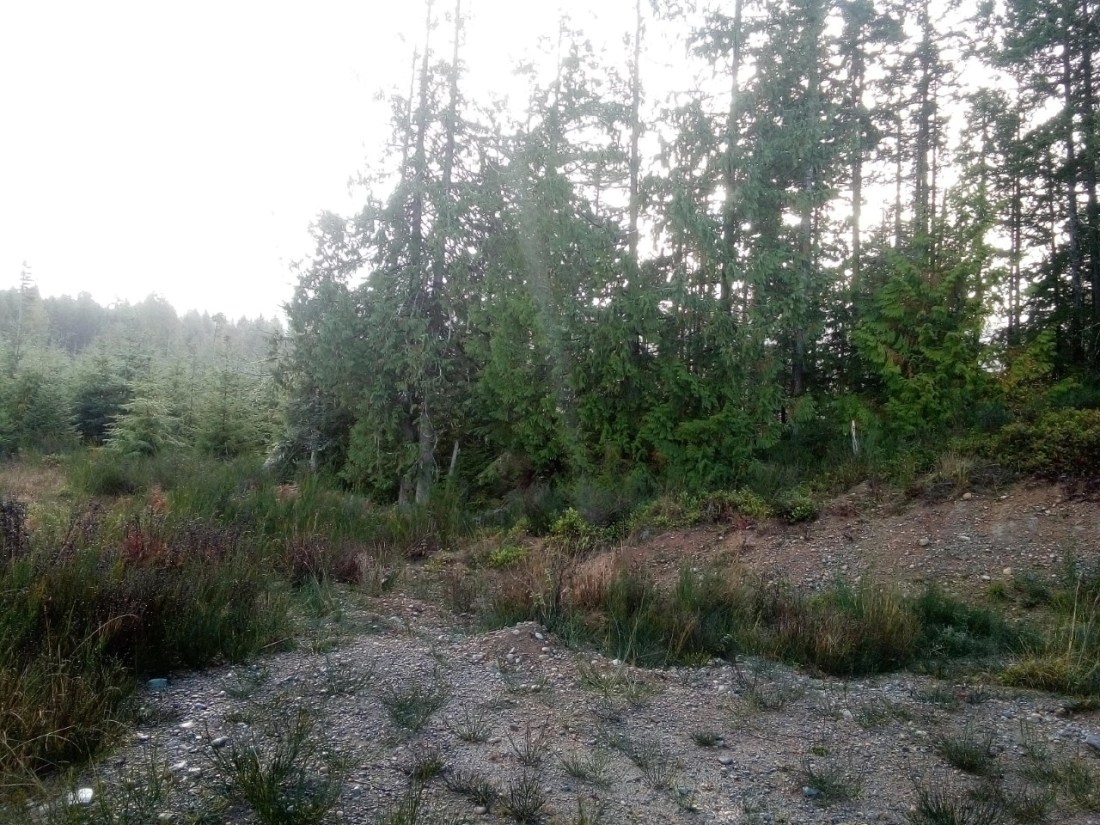
Last Sunday’s aching run was a miserable day. Cold, wet and windy.  I did not want to hit the trails.  But I went out anyway.  Aching.  And while I was thinking these thoughts, the clouds lifted momentarily.  There was a bit of sunshine, and I stopped, and I took a picture.  And then I kept running.  And the ache in my hip got a lot worse.  But it didn’t stop me.  And I made it home just fine.

What are the Chances?

Yesterday I wanted to run for an hour.  Not 59 minutes. The difference is psychological but real.  There’s comfort and completeness in that extra minute.

Sixty minutes means thirty out and thirty back.

Our home is surrounded by forest and trails.  I have many options, but one favourite – a short jog down the street and I disappear into the woods, unlikely to encounter anyone in a world of silence.

I climb, and descend, sometimes fast, sometimes slow, usually somewhere in between.  Yesterday I checked my watch, once or twice, determined to turn around at the thirty-minute mark.

Twenty-four minutes into my run, on an isolated hilltop that overlooks our neighbourhood, I sensed where the run would end.  I have been running long enough, decades now, to have a feel for pace and distance.  It’s almost instinctual.   

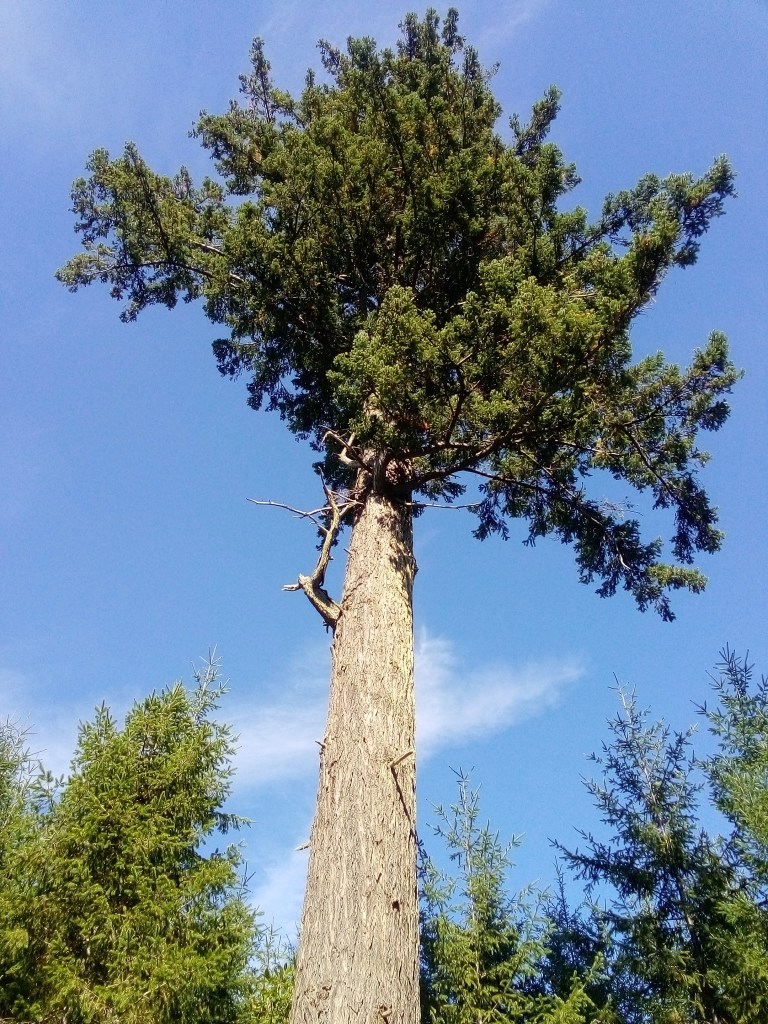
The tree.  I would finish at the tree. 

There are tens of thousands of trees within miles of our home. 

There’s one that stands out. 

Pictures don’t do it justice.  My pictures at least.  But it is wide and thick and towers above everything around it.  It’s a special tree.  The kind of tree that protesters would chain themselves to, if a logging company ever threatened to cut it down.

What are the chances?  What are the chances that tree, my favourite tree, would be exactly thirty minutes from my home, along my favourite route.

It got me thinking.  About something that happened two weeks ago.  I ran a trail race, with a friend.  “Trail’ doesn’t do the event justice.  Almost twenty miles long, with 4400 feet of elevation, it’s a never-ending series of ascents and descents.  Nothing is flat.  Nothing is easy.  Everything burns.

About four hours in, my buddy was in pain – run stopping pain.  He moved to the side of the trail and stopped moving.  He’d been hurting for awhile but had never stopped.  He’s not the kind of guy to stop.  Ever.  So, I knew he was in agony.  And just then, at that very moment, another runner came by, her palm open, salt tablets in her hand.  She offered him a handful.  He swallowed them.  And almost instantly his pain lightened.  His legs loosened.  He was moving again.  What are the chances?  We’d been on the course for hours.  He’d been stopped for seconds.  At that very moment, in his time of need, another runner, carrying exactly what he needed, came by. 

He and I talked about that moment.  We talked about God and chance, about life’s profound moments and what lay behind them.

I work in a unit that investigates homicides.  Fortunately, on the island we live on, they are relatively rare.  Relatively is a relative term.  Because our plates are full.  There is no shortage of work.  Even though sometimes months pass between murders.  Months. 

Until a few weeks ago.  When there were two murders within hours.  Over a hundred miles separated them.  Only minutes separated them.  What are the chances?

I don’t know.  Perhaps there are answers.  Maybe none exist.

Sixty minutes.  Salt pills.  A hundred miles apart.

One tree.

Scattered Bones

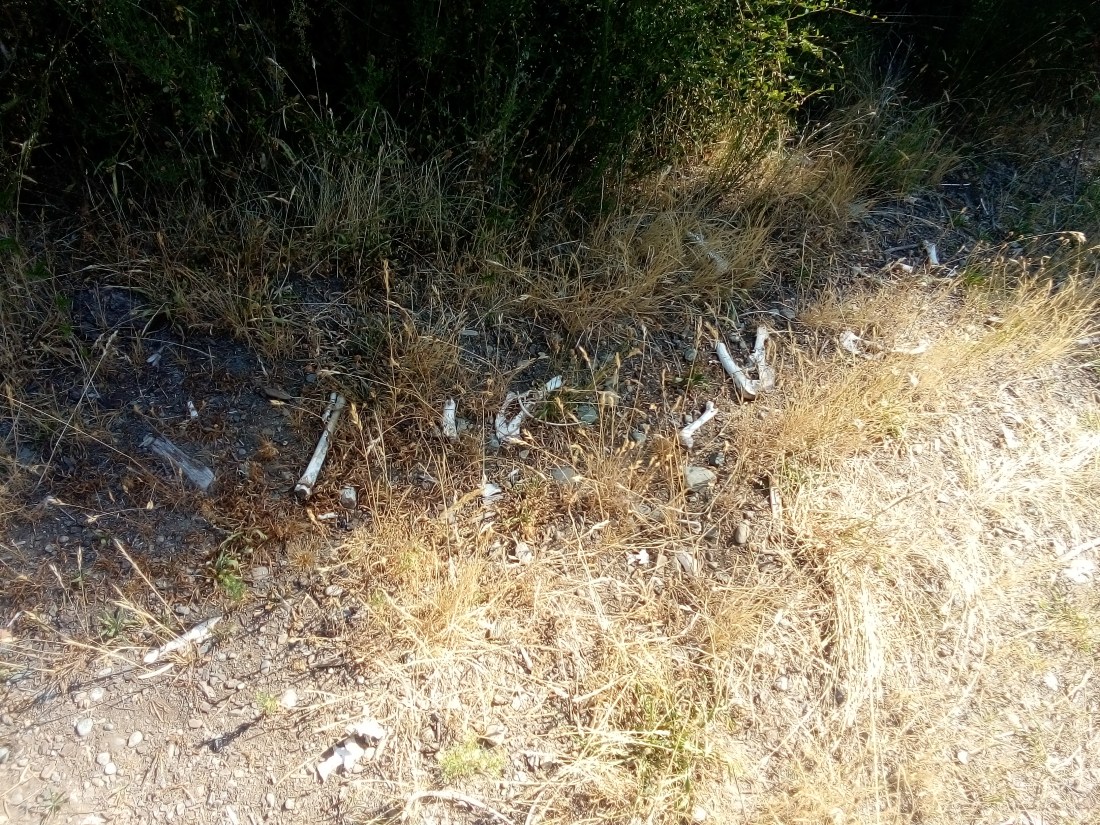
Evidence of a kill. 

At the end of a side trail, not heavily used.  I might have been the first person standing there in days, weeks – maybe even months or years.

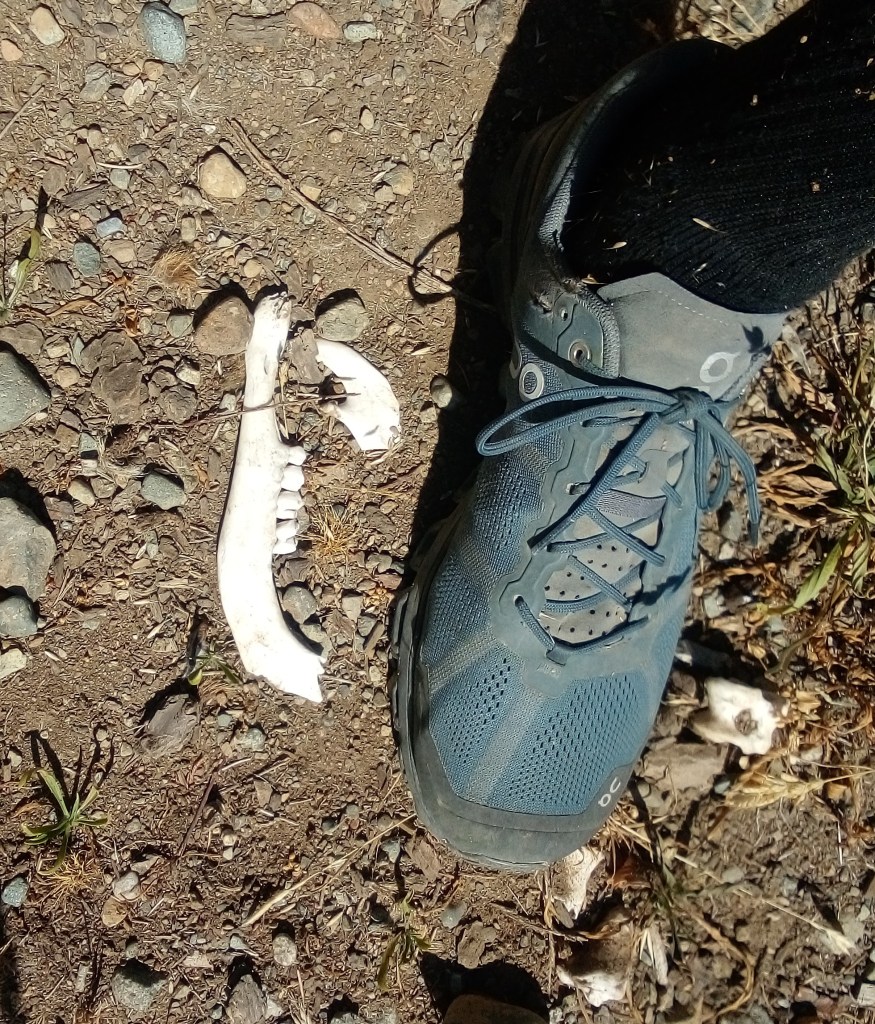
Scattered bones – bleached white.  A deer ripped apart, the spinal cord severed, a piece of a jawbone, a smattering of teeth.

An awful death.  Perhaps, mercifully, a quick one. 

A vivid reminder that our forests and trails, so near to our homes, are a different world.

I’d hadn’t gone this deep into the woods for weeks.  Since I’d seen a bear just minutes from our home.  That was six weeks ago.  On a well used trail at the junction of two paths.  If I left my home right now, I could be there in five minutes.  Or less.  My bear encounter happened at midday.  A warm day.  The perfect day for a quick workout.  Hill repeats.  Up and down, up and down.  Strengthen the legs, stress the lungs, tune out the world.  Music blasting in my earbuds.  I stopped tuning out when, on the last downhill, I glanced to my right and saw a black bear ambling up towards me.  Maybe 30 or 40 feet away.  A scenario I’d imagined a thousand times. I stopped running, pivoted, walked backwards down the hill.  Slowly.   Yanked out my bear spray.  Pulled the cord on the noisemaker clipped to my chest.  Knew in my head that black bears rarely attacked people.  Feared in my gut that this one would.  Kept retreating.  Got to the bottom.  Saw the bear at the top.  It looked at me, curious and calm.  And kept on going, towards the woods, away from me.

A few days later, I ran again on the same hill.  Head on a swivel.  No music in my ears.  A little scared, but knowing the longer I waited to go back, the less likely I would be to do so.  Still, that was close to home.  Close meant comfort.  At the junction where I’d seen the bear, I could see dozens of houses and cars passing below.  It was practically my backyard.

The side trail with the dead deer was not my backyard.  I’d planned this run for days, and then talked myself out of it the night before.  Because I was scared.  Scared to venture far from home.  Far from houses and cars and a pretty subdivision.  Into the land of cougars and bears.  I talked myself into a safer run.  Along well traveled roads, to a public park filled with hikers and mountain bikers. 

Then I woke up.  And talked myself out of the talking out. 

Maybe it was because an article from a trail running magazine popped up on my Twitter feed with an article about the rarity of bear attacks and the effectiveness of bear spray.

Maybe because I thought of my daughter.  The fears of a five-year old can be overwhelming – unfamiliar situations, unexpected change, a bug on our trampoline – overwhelming and every bit as real and powerful as the primal fears of an adult.  When my daughter is scared, my wife and I encourage her to face those things that frighten her.  To gain strength, incrementally, by winning small battles against little terrors. 

Or maybe it was just because I love to run on hard packed dirt, baked dry by a month of heat, in the midst of towering, never-ending evergreens.

So, I went for that run.  I added a knife to my arsenal.  Razor sharp, encased in a multi-tool which I carried with me for the entire run.  The multi-tool in one hand, a rock in the other.  I banged them together frequently.  “Make noise,” the experts say.  Scare the bears off before they see you. 

I made noise all right.  No earbuds on this run.  Blue Rodeo blaring from my cell phone.  My rock smashing into my multi-tool whenever I approached a blind corner.

I made noise, and scared a lot of birds, who flew off as I approached. 

I don’t know if I scared any bears, or cougars.  I certainly didn’t see any.

But I smelled death.  The unmistakeable odour of decomposing flesh hit me hard.  Twice.  The rotting carcasses must have been just meters off the main path that took me further and further out. 

Further and further out to the side trail, which ended with scattered bones and an awful death.

An awful death and a necessary run.

A run that replaced fear with confidence.

A run that reminded me of why I was scared in the first place.

Top of the Hat

Deadly car crashes.

Endless road work.

Traffic congestion.

Incredible views.

All synonymous with ‘the Malahat’ – both an 1100-foot mountain and a twisting highway on Vancouver Island.

When conditions aren’t ideal it’s awful to drive – no lights illuminate the road, few barriers separate speeding cars from massive trucks, and rain, fog, and snow slicken the pavement and obscure already obstructed views.

Oh, but the view from the summit is extraordinary. 

Just hundreds of meters away from the congested highway is a mostly deserted trail.  Last weekend I ran to the summit.  In two-hours I saw two dirt-bikers and no one else.  On an island of several hundred thousand people, I was alone.

The trail to the summit was mostly satisfying – hard-packed dirt and gradual elevation.  Closer to the top, a rocky pathway replaced the earthen trail.  Running slowed to a jog, every step a potential twisted ankle or inglorious fall.

Soon after, running ceased altogether when I chose the direct route to the top.  Straight up a gully that must be a continual stream of water from November through spring.  But last weekend, on a hot dry day with summer on the horizon it was dry and completely accessible.  I grabbed a broken branch and used it as a walking stick to help as I scrambled my way up.

The scramble was worth it.

Oh, that view.

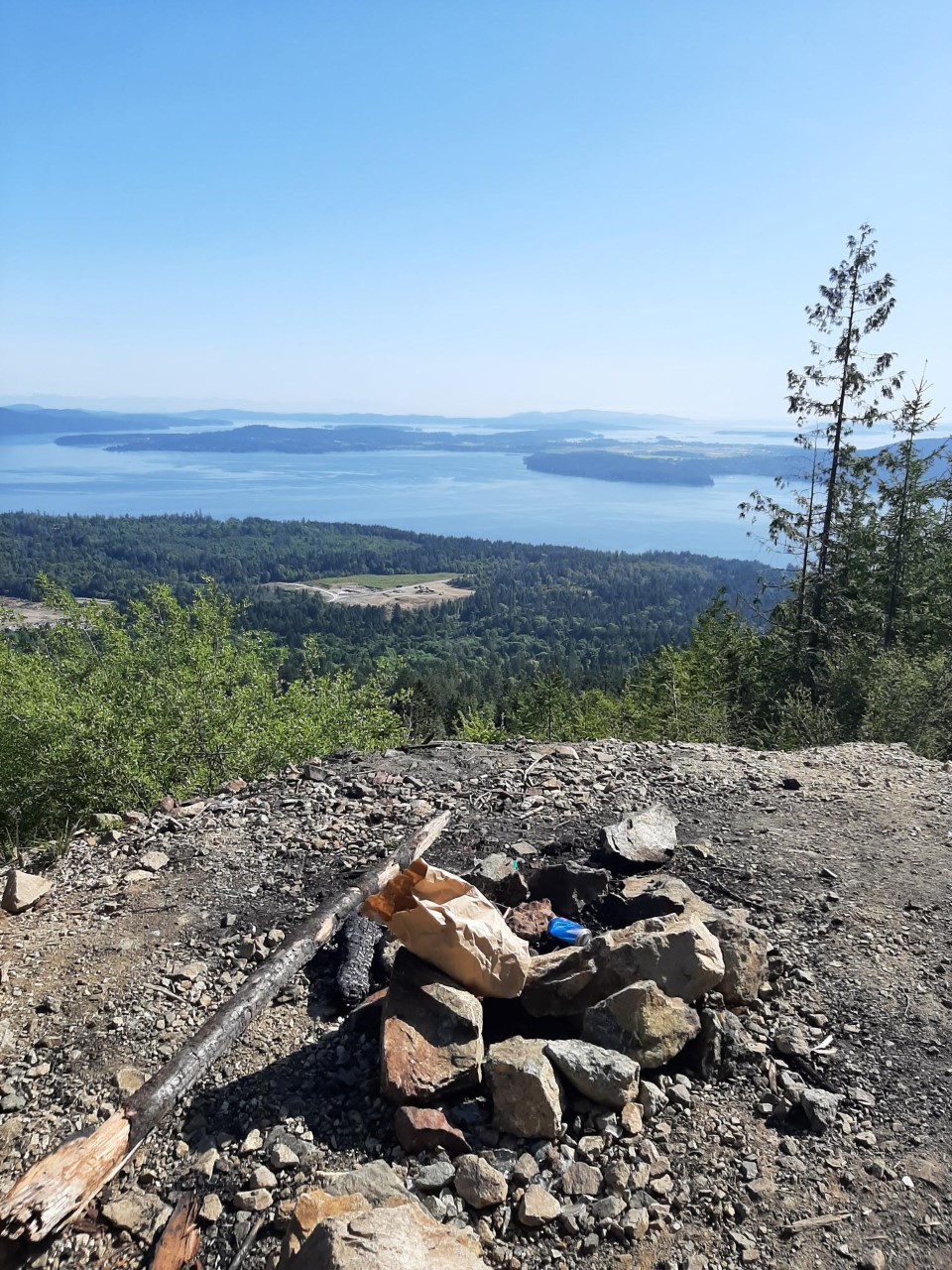
Blue sky, bluer ocean, distant mountains, a forest canopy, and an international airport as small as a postage stamp.

Travellers from across the country and around the world drive up the Malahat highway, exit at the scenic viewpoints, and revel at the glorious view.  Thousands – tens of thousands – do it every year.

Far fewer take the trail to the top.  Dozens.  Hundreds.  Runners like me.  Hikers, mountain-bikers and quad-riders.

We are drawn by the same thing.  Beauty.  Magnificence.  Nature’s wonders.

The attraction is so understandable.  The destination is worth the journey.

Which makes the next part so hard for me to understand. 

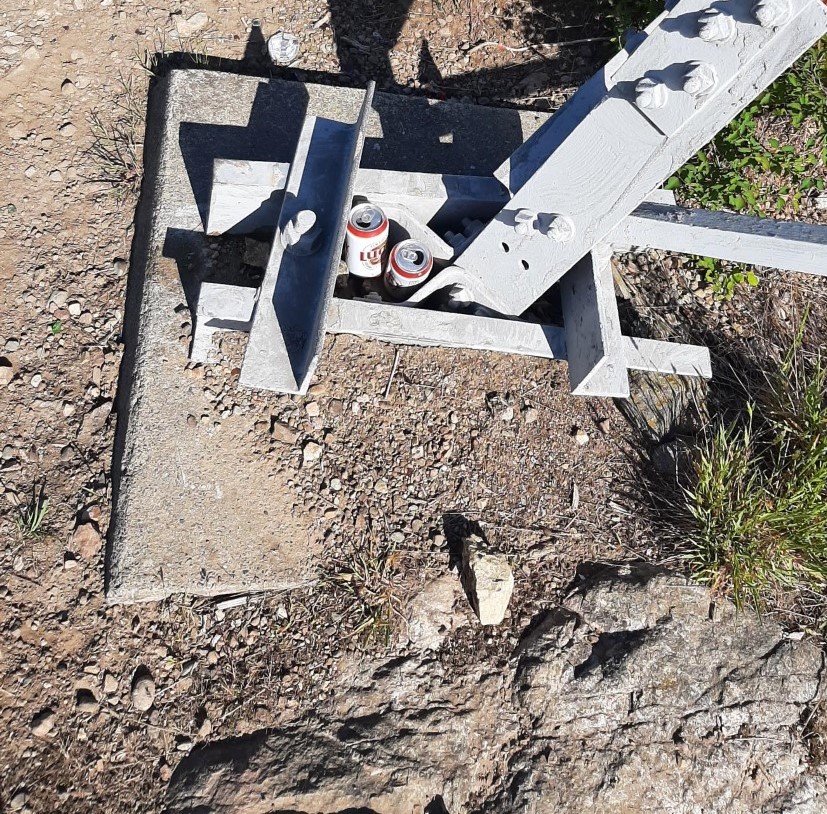
Garbage at the top.  Beer cans.  Plastic.  Paper.

Lucky lager cans tucked into the base of a hydro tower. A fire pit filled with garbage.

Who does that?  Who makes the effort to get to the top precisely because it is beautiful and then purposely despoils that beauty?  The beer cans tucked into the hydro-tower.  More cans, paper, and plastic left almost lovingly behind in the pit.

I don’t have the answer.  My gut reaction is that anyone who does that is an asshole.  I hate using that language in my writing, but it’s hard to feel otherwise.

But maybe that’s not fair.  Maybe the person who makes the effort to get to the top and then discards their trash for others to clean is me on a bad day.  Maybe it’s you.  Those people are someone’s neighbours.  They’re the people we see at the grocery store.  People we hire, work with, or work for.  Maybe our friends.  Whoever they are, they walk among us.

I try and understand.  Try to be sympathetic.  Usually, my anger and disgust overpower empathy. 

How are we supposed to understand people who clearly appreciate beauty, yet are so reckless in making the very place they worked so hard to arrive at, less beautiful?

There may be a million answers to that question. Philosophical, spiritual, practical.  There may be no answers.

I’ve given up trying to understand.  I find great wisdom in the words of Lee Child.  Author of the massively best-selling Jack Reacher series, something he wrote several books back has stuck with me ever since – “People are complicated.”

I’m not sure truer words have ever been spoken, and I don’t think a philosopher, or a Nobel laureate could say it any better than that.

People are complicated.  

Even at the top of the Malahat.