Meaningless

Featured

Yesterday afternoon I was sitting on the front porch on a beautiful summer’s day.  I had just finished writing the piece below.  My wife came out to tell me she’d received a call from her sister telling her that Donald Trump had been shot.  I rushed inside and put on CNN and watched video of the former president surviving an assassination attempt.  I still feel sick thinking about what I saw and what it means for our world.  Politics took a back seat to humanity, the preciousness of life and the precariousness of democracy when violence supersedes debate and elections.  This morning I’ve been thinking about Abraham Lincoln, the Kennedy brothers, Martin Luther King, and the afternoon over 40 years ago when my dad walked into our living room to tell me that Ronald Reagan had been shot.  Before I turned on CNN, I turned off the show my daughter was watching.  A kids show.  I felt I couldn’t shield her from reality.  She would eventually hear that Trump had been shot.  So, I told her, figuring it was best that she heard it from me.  Eerily reminiscent of my father telling me about another attempted assassination many years ago.  The piece I wrote below is about “meaning.”   When it comes to meaning I have many questions and few answers.  I worry about the world my daughter is growing up in.  And, whatever the future holds, I pray that hope triumphs over fear, and peace wins out over violence. …

My daughter teases me about only buying her “meaningful” books with titles like Time is a Flower and I Like Myself.  She’s right.  She has a thick stack of thin hardcovers targeting girls written by authors trying to boost the self-confidence and resilience of their young readers.

I search for meaning constantly, and I make choices about what to do based on that search.  As a teenager, I loved the Beverley Hills Cop movies.  The eighteen-year-old that still lives somewhere inside me almost screamed with joy when I saw that Netflix just released the latest movie in the series, ‘Axel F.’

A few nights ago, I was alone at home at night.  All I had to do was press a button and summon Eddie Murphy as Axel Foley to my TV screen.  I couldn’t do it.  I could not give up myself, and my time, to what would undoubtedly be two hours of laughter, gunfights, and car chases.  I scrolled aimlessly for awhile, and then sought out a documentary on September 11th.  I watched firefighters walk up stairwells and people plummet from buildings.  It was deeply unsettling.  And I went to bed and slept well.

Meaning is comforting.  It’s hard to describe how happy I felt when my two most recent book purchases arrived in the mail.  Sebastian Junger’s In My Time of Dying and James Lee Burke’s Clete.  Junger writes about nearly dying from an aneurysm, and, how on the verge of death, his deceased father appeared above him, and a dark void opened below him.  His heart was beating, he was conscious, and he saw these things.  Junger, an atheist, narrates his own near-death experience and then explores the phenomenon, of those who have clinically died, come back, and recounted lights, tunnels, and encounters with dead relatives and friends.  In My Time of Dying is full of love, mystery, purpose, and quantum physics.  It leaves the reader with wonder, questions, and hope.  Burke is my favourite novelist.  His Dave Robicheaux novels pull you into Louisiana and immerse you into crime, tragedy, honour, friendship, and love.  Burke too writes of mystery and wonder, and his words convey the way in which we live in a world where beauty and horror are everywhere all at once.  Beauty and hope always win, but good people pay a price for those victories.  James Lee Burke is a gift to our world.  His words nourish me.

I can’t even go for a damn run without being on some kind of quest.  The problem is I don’t always know what I’m searching for.  When I was forty-years old I qualified for the Boston Marathon.  Injury prevented me from actually running Boston.  I’m 13 years older now and still haunted by the personal best time I ran over a decade ago.  I believe that, despite my age, I could beat that time by training really hard, and staying injury free.  However, I haven’t been injury free for over a decade.  My heal constantly hurts, often joined by one or both of my knees.  And the time it would take to do the type of training I’d need to do is precious time.  Every three hour long run on a Sunday morning is time not spent with my family.  And that’s what really matters.  So, I run a bit less, and nurse my injuries along, and pursue running from entirely different angles like beauty and health.  Beauty in the landscape I run through, and health is my pursuit of trying to maximize the time I have in this world with those I love.  So, while almost daily I fantasize about running fast times and setting a new personal best in the marathon, reality usually entails finding meaning in dusty trails that lead to ridgelines I have yet to explore. 

My daughter does acknowledge my capacity to give up the search for meaning.  At Christmas I usually buy her the latest edition of the Guiness Book of World Records. Together we flip through the pages and marvel at the not so meaningful things our world has to offer like Mr. Methane, “the longest working flatulist in the world.”  On my own, I would never choose to read about a world-class farter.  But with my daughter beside me nothing means more.

I find meaning in writing these words.  In somehow translating swirling thoughts within me to something concrete.

… I’d just finished writing that sentence when my wife walked out on the porch.  And everything became meaningless.

Behind the Curtain

Featured

Early in my career I remember thinking, “everyone should be a cop for ten or fifteen years.  No one should do it longer.” 

A few months ago I retired from policing after twenty-four years on the job. 

Policing opened my eyes to worlds I did not know existed.  I’d grown up in a loving middle-class family in small-town Ontario.  I knew little about life other than what I’d learned in school, sports and church. 

Within weeks of being a cop I’d seen domestic violence, daily crime, and death.  Naïve me was shocked that we regularly arrested people for impaired driving, often in the middle of the day.

I’ve written elsewhere that the great privilege of the job, and the great burden of the job, are one and the same – the glimpse behind the curtain it affords into peoples’ lives, and into the dark corners of society.

I’m still working – for the government now.  A ‘normal’ job, with normal hours.  I am never on call, don’t work night shifts, and instead of commuting ninety minutes a day, I walk upstairs in the morning with a cup of coffee to my office in our home.  I feel like I’ve won a lottery where the grand prize is time and sleep. 

I have my physical and mental health.  I am extremely grateful for that.  And I feel guilty about it.  I have friends and former colleagues who have been injured, physically and psychologically.  Serious wounds.  The lucky ones have healed.  Others suffer daily.  Many live somewhere in between.

I never feared for my life, and I never came close to firing my gun in the line of duty. Something else to be thankful for.  And something else to feel guilty about.  How would I have performed in a critical incident where death was imminent and I had to react?  Maybe even shoot someone.  I’ll never know.  And I’ll always wonder.

I was affected by the things I saw and did.  Working in homicide I gained intimate knowledge of the last, awful moments, of victims’ lives.  I saw dozens, if not hundreds of bodies, during my career.  I have forgotten almost all of them.  The details aren’t buried deep inside me. They’re just not there.  Even the most consequential deaths fade.  When I was in uniform, in Ontario, a young man died in front of me, crushed behind his steering wheel.  He was unconscious, but alive.  He swallowed and died.  I think about him and his family fairly often. But  I’m not haunted by what I saw.  Almost ten years ago a child died of natural causes.  I spent time with him in the hours before his death.  There was no indication he was unwell.  His death shocked me.  It shook me.  I went home after that nightshift and told my wife it was one of the worst shifts of my career – one of the worst things that had happened in my life.  That boy deserved to live.  I wish my memory of him was stronger.  But the details of that night have faded.  The details of so many things I’ve seen have faded.

I wonder how many thousands of miles I’ve run in the last twenty-four years.  If I averaged twenty miles a week, which is probably about right, then, as a cop I ran approximately 24,960 miles.  The circumference of the Earth is 24,901 miles.  Metaphorically, I ran around the world.  Those runs helped me leave work at work.  Those runs helped turn traumatic incidents into fading memories. 

I read hundreds of books in those twenty-four years as well.  Each and every one of them transported me somewhere else.  Those books took tiny pieces of me along with them for the ride.  Tiny broken pieces that got stitched back together by the words of authors who transported me away from reality.  A different way of travelling around the world.

At the start of my career, I didn’t know if I was capable of being a cop.  I wanted to test myself.  I wanted the challenge.  I wanted to do something that mattered.  I wanted to look behind the curtain.  I’m thankful I got to do that.  For better, and for worse, it’s made me who I am today, as I set out on the next chapter of life.

For a Moment…

Featured

My daughter is seven. 

I turned seven in 1977. Toronto Blue Jays’ bleacher seats were two dollars.  Jimmy Carter was President.  A soldier who’d fought in World War I and World War II visited our home.

My dad turned 7 in 1950. Harry Truman was President.  The Korean War began weeks after my father’s birthday.

My Dutch grandfather turned 7 in the 1920s.  Born during the Great War, that 7-year-old boy did not know that he would live under Nazi occupation and that his daughter, my mom, would be born as fighting raged around them.

I have no idea when my great-grandparents turned seven.  It must have been in the late 1800s.  I know nothing about them.  They are as mysterious to me as medieval peasants.  Their lives mattered.  And they are invisible to history.

Last year, a friend at work gave me a copy of Marcus Aurelius’ Meditations.  A pillar of Stoicism, Aurelius and the Stoics encourage us to recognize and embrace our impermanence.

I think about impermanence daily. I always have.  But becoming a dad heightened that tendency.  Being a dad is like impermanence on steroids.  Every day my little girl grows up a little more and becomes less of a little girl.

She talks a lot.  Like when I’m sitting on the couch, trying to write this.  Part of me, inside, screams in frustration, yearning for silence so I can concentrate.  And yet, every word is precious.  Every silly, nonsensical thing she says, like, “what squishy butt isn’t marshy.”  (The answer is marshmallow). 

Impermanence is everywhere.  Yesterday I found a photo of myself from almost ten years ago.  I looked at it and thought, ‘I look pretty much the same’.  I showed it to my wife and she said, “You look so young!”

A few months ago one of my favourite trails was closed when an old-growth fir tree toppled in a windstorm.  For years, that tree had clung to the side of a hill.  It was massive and precarious, leaning at an angle that suggested it would fall any moment.  It did not surprise me that heavy rain and high winds sent it crashing to the ground.  It may have been hundreds of years old. 

Last fall I planted a sapling in our backyard.  It didn’t survive the winter.

 Marcus Aurelius  wrote, “Our lifetime is so brief … Consider the abyss of time past, the infinite future.  Three days of life or three generations; what’s the difference.”

I’ve gravitated to the trails over the last few years.  In part, it’s because the dirt paths are much gentler on my aging joints than unforgiving pavement.  But there is more to it.  Our forests are a never-ending reminder of impermanence. 

Stoicism invites us to put impermanence front and center in our lives.  To live neither in the past, nor in the future, but in the moment.  It is not a cliché to say that this moment, is all we truly have. 

And yet these moments span generations.  I look at a picture of myself beside the fallen tree and I see an expression I recognize as my father’s in my own face. 

This morning my daughter commandeered a bathroom.  She put a “Keep Out” sign on the door and told us she was turning felt into silk.  She called out for purple and yellow markers, scissors, and tape.  After thirty minutes she emerged and handed me a paper tie to wear when I dress up to go out for dinner tonight.  On the tie she’d written “you are the best dad ever.”

My daughter is seven.  This morning, for a moment at least, I was the best dad ever.  I know that too is impermanent.  A few years from now, a teenage girl may feel dramatically different about her father.

Stoic philosophy reminds me to accept and embrace the reality that trees grow and trees fall.  Daughters are young and silly and daughters grow up.  Dads age, and dads hobble and dads look more like their own fathers.  Each of those moments is all that we have.  And yet, those moments bind us to the past and anticipate our impermanent futures. 

Flat Miles

Featured

Flat miles.

There’s no such thing on Vancouver Island.  Up and down, up and down.  Every run is a series of ascents and descents. 

Southern Ontario is gloriously flat.  I took advantage of that a couple weeks back, when I was home, alone, visiting my family.  I logged a lot of miles.  It was easy to do.  I had lots of time, and few responsibilities. 

I ran every day, except one.

Things happened in Ontario.  And I ran.

That’s the thing about running.  It’s with you always.  Wherever you are.  A runner can always run.  A runner can structure his day around a run.  Or a runner can squeeze in a run even when the day is busy and unyielding.  A runner finds time to run.

And think.

I had lots to think about when I ran in Ontario.

My mom.  Recovering from a stroke.  Working so hard on her rehab. Moving so well.  Speaking so well. I was very proud of her.

My dad. We ran together.  That was special.  He’s been doing it for five decades.  Part of the first great running boom of the 1970s.  He’s nearing eighty and still running.  Runners run.

My grandparents. I visited my grandfather’s grave. Born during the Great War, he and my grandmother started their family during World War II, in occupied Holland. My mother and her twin sister were born as the Battle of Arnhem was fought nearby. A famous battle – The Bridge Too Far battle. My mother’s twin died shortly after she was born, in a starving nation, torn by war. My grandmother’s name is not on the gravestone. Her ashes were scattered elsewhere. In my memory, they are always together.

My wife and daughter.  They did not make the trip.  My daughter is too young to be vaccinated.  There was an emptiness to this trip home, because my entire family was not together.

Guelph.  A small-town in Ontario.  I miss small-town Ontario.  I miss the brick buildings, Main Streets, and cenotaphs in town squares.  I miss walking in a small-town.  I miss feeling I’m part of a small-town.  I didn’t realize how important it was to me until I left it behind.

ACAB. An Acronym for ‘All Cops Are Bastards.’  Spray-painted on the wall of a cake  shop in Guelph.  I know a lot of cops.  All cops are not bastards.  I thought about how widespread anti-police sentiment has become.  I thought about the assaults my colleagues in Victoria have been subjected to recently.  Serious assaults.  I thought, if the ‘C’ in the acronym was replaced with a letter that stood for a different group, it would be a hate crime.

People.  I didn’t fly home to wander through small-towns.  I went for people.  Like my wife’s best friend and her husband.  They have become my friends.  A trip back home without seeing them is unimaginable.  People I only met a few years ago, are now important parts of my life. 

Life takes twists and turns.  I had dinner with my ex-wife. For the last 18  months, she has been on the frontlines of the battle against Covid.  Her efforts have kept vulnerable seniors alive. She has endured immeasurable stress.  She’s led her staff through difficult times.  I am proud of her.

In life’s twists and turns, there are constants.  Like my brother, and his wife and their children.  They are proverbial rocks in my life.  We don’t talk often and see each other rarely.  And yet we are there for one another, with a closeness and comfort level that transcends distance and time. 

I thought about the people I did not see.  My friend Stitch.  A man who has suffered, and endured, and come out the other side.  Strong and resilient.  If I called him and said I needed him, he’d drop everything and fly across the country in a heartbeat. No questions asked.

I thought about some people I have not seen in many years.  Once good friends who I let slip away. 

These are some of the things I thought about when I ran flat miles in Ontario.  It was hotter than I would have liked.  No crisp cool autumn days. And the colours of the leaves were muted, not vibrant.

Runners run.

And runners think.

And when this runner arrived home, in rainy, hilly, British Columbia, he was greeted by a daughter who shrieked, “daddy,” and he was a hugged by a wife he loves and missed, and he was thankful for everything he has, and everything that was.

The Hard Miles

“The hardship of running somehow softens the hardship of life.  Running turns the madness into music.”

Those words, from the foreword to Phil Hewitt’s ‘Outrunning the Demons’ capture the essence of this book – Life is hard.  Running helps.  Hewitt himself was stabbed, beaten and left for dead alongside a South African highway.  He survived.  Running helped.

And inspired him to collect the stories of others who, in their darkest hours, found solace in running.  People shaken by grief, addiction, disease, injury, and mental illness – in the worst of their pain, running helped them survive.

As is often the case, I write this on the couch, my daughter beside me.  A mini-crisis has just passed.   Strawberry yogurt everywhere.  “Oh no, I got some on my pajamas,” she yelled.  A very big deal for her.  Less so for me.  I responded that if yogurt spilled all over the sofa, and covered her and painted the ceiling, it would be okay.  We would fix it.  We would survive a Yogurt Disaster

As the yogurt spill played out, I looked out our front window and saw a runner, in her bright yellow vest, racing along a path near our home.  I know her.  A little.  She runs every day.  I’ve seen her running in deep snow on days when I struggled for hours just to shovel our driveway.  In winter’s darkest days she is out there – in driving rain and howling winds.  I don’t know her story.  But I suspect she needs running.  Needs it just as much as food, and water and air. 

That’s how I feel too.

Not many years ago, someone very close to me was diagnosed with cancer.  I was terrified she would die.  It was a bad year.  Stress, worry, uncertainty and fear churned within.  So I ran.  Signed up for a marathon and trained for it not because I wanted to.  I had no time goal.  The distance was no great challenge.  I’d run marathons before.  I entered that marathon because I needed to.  A lot changed in my life that year.  But running was a constant that helped see me through the worst and emerge on the other side.   

The other side is a new life.  A life that might be very similar to yours.  A spouse, a child.  A career with constant stress, modulating daily, sometimes hourly, from moderate to severe.  Always present and always a roller-coaster ride. 

Yesterday was Easter.  My wife and I watched a day of joy unfold as our daughter hunted Easter eggs.  We watched as her grandparents and aunt showered her with love, and chocolate, and placed a pink Easter bonnet on her head.

And there was sadness too.  My parents are a long way away.  So is my youth.  I remembered Easter when I was a child.  Chocolate and church and sunshine.  Yesterday I wanted to hug my mom and dad and my brother and his family.  And be with them and tell them how much I love them.  And thank them for those wonderful memories.

One of those memories is music.  “Morning has Broken.”  A song for the ages.  A song that captures light and life and spring and sunshine.  An Easter song.  So yesterday, in the midst of it all, on a bright beautiful April day, I ran to the trails and listened to Cat Stevens sing that song.  I played it over and over again.  I found a valley and a lone daffodil.  Just the one, in a sea of grasses and weeds.  And I thought about it all.  And was thankful for everything.  Joy and youth, light and life, family and friends. Running and hard miles.

More Things Matter Less

Two people I didn’t know died recently.

I learned about them, their lives, and their deaths, from grieving friends.

Their deaths were unexpected.  One from a chronic health problem that deteriorated rapidly.  The second also “natural,” but without warning.  Both had young children.  Both left grieving families, friends, and colleagues

Natural causes.  A phrase we’ve all heard thousands of times.  Two words that don’t convey the pain death leaves in its wake.

I began to think of death a little differently not that long ago.  It was something I heard on a show that has become a big part of my life.  The Rich Roll Podcast.  Rich is an ultra-endurance athlete, a vegan and an inspiration.  He challenges himself and his listeners to be their best selves.  His guests share their lives with Rich because he’s authentic, curious, and humble.  He radiates warmth and trust.  He’s become a fixture in my life.  Like a friend I’ve never met.  Although I did meet him once.  Travelled across the country to hear him speak and met him briefly afterward.  Bought a t-shirt which I still have.  Very worn, and very torn, I still wear it proudly.

A year or so ago, one of Rich’s guests spoke about aging, and longevity – with a focus on people around my age – forty and fifty.  Not old, but not young.

The guest said something like ‘Nature doesn’t need you anymore.’

Thought provoking words.  Not spiritual, not healing, not sugar-coated.  Evolutionary.  We are all animals.   Dying is wired into our DNA.  And by our forties and fifties, most of us have had children, and aren’t going to have any more.  Nature – cruel, merciless – doesn’t need us.

A lot of things don’t need us.

Work doesn’t need us.  If we are lucky, we have careers in which we are fortunate enough to make contributions – to our co-workers, to our organizations, to the world at large.  But, at work, each of us is completely replaceable, regardless of what we do.  You and I might be missed.  But we’re not necessary.  Not essential.  We’d be replaced and the machine would grind on.

Things don’t need us.  We surround ourselves with so much that is non-essential.  So much plastic, so much made overseas, so much packaging.  Inert crap, that adds little value to our lives.

The news cycle doesn’t need us.  It gorges, spits out, and moves on.  Trump today – gone tomorrow. 

The planet doesn’t need us – alive, we drain it, suck out its exhaustible resources.  Every second we breathe, we’re part of the problem.  Dead, we return to the earth.  Giving a little bit back after all we’ve taken.

But if a lot of things don’t need us – a lot of people do.

Our communities.  Our friends.  Our families.  Our children.

Not knowing that I’m writing this – never knowing anything that I write about – my five-year old daughter just started talking about death. She said to me “I bet you die right now.”  I reassured her and told her that wasn’t going to happen.

I did not tell her that nature doesn’t need her father anymore.  She’s five.  She still needs her dad.  Needs to cover my face in shaving cream like she did a couple of hours ago.  Needs to paint my nails pink and spray me with perfume like she did right after that.

And I need her.  For as long as I can hang on. 

Which is another reason Rich Roll has become a mentor and inspiration.  Nature is merciless.  Accidents happen.   Diseases ravage.  Aging never stops, and always takes a toll.  But there are things we can do that increase our chances – increase our chances to live longer, be healthier, and find contentment in whatever path or paths we choose along the way. 

More things matter less than ever to me now.  Things I used to be passionate about like baseball and politics.  Not that long ago they were central to my life, now they exist on the periphery.

But if many things matter less, then a few things matter more.  My family.  My friends.  Seeking rewarding work – not working for rewards.  Reading. Writing. Running.

And living a life with pink nails, and a shaving cream head.

A Bear Out There

There’s a bear out there.  Not far from my home.  Somewhere.  Drinking from the creek that cuts through our neighbourhood.  Eating the berries along the trails that connect our community.  Foraging through bins on garbage day.

Signs at trailheads warn of recent sightings. It’s a black bear, not a grizzly.  While black bears are unlikely to attack humans there are no guarantees.  Google “Black Bear Attack – British Columbia” and you will get multiple hits – news stories that are weeks or months, but not years old.

It still feels very foreign to me, a relative newcomer to BC.  I grew up in Southern Ontario and the closest I came to a bear was at the Toronto Zoo.  A bear was as foreign and exotic as a hippo or elephant.

Not on Vancouver Island which has one of the densest populations of black bears in the world.  I step outside the house, scan the forests that surround our small town, and know that there is likely not one bear out there, but dozens.

That knowledge affects every trail run.  I do not obsess about it, but I am more than conscious that around every sharp corner, or in the deep brush beside me, a bear may lurk.  That invisible bear may not be poised to attack and is likely more scared of me, than I am of it.  However, more than once I have imagined rounding a bend and encountering a mother bear and her cubs.  Whenever that scenario plays out in my mind, it does not end well for me.

I take some precautions.  Or one precaution at least.  Jammed into the front pocket of my running vest is a large can of bear spray.  On most runs, I practice pulling it out so that doing so becomes as instinctive as a gunslinger sliding a pistol from his holster.  I visualize an encounter I hope never happens.  I startle a bear. We both freeze.  I hold my ground hoping it will just amble away.  It does not.  I yell, hoping to frighten it off. I fight my body’s instinct to turn and run.  I stare at the bear, continuing to yell.  The bear spray is in my hand now.  I back up slowly.  The bear is still.  Do I wait for it to pounce?  Or do I attack first, shooting a stream of thousands of distilled hot peppers into the bear’s face?  Causing it real agony to prevent my own potential agony?  What if I unload the cannister of spray at the bear – and miss – creating a very angry bear, and a very unarmed me?

Questions which I hope are never answered.  A scenario which I hope never plays out.

A chance I am willing to take every day I run in the woods.  Because of the beauty that surrounds me everywhere.  Mountains and forests.  Grueling inclines and distant vistas. Silence and serenity.

Something rustles in the underbrush.

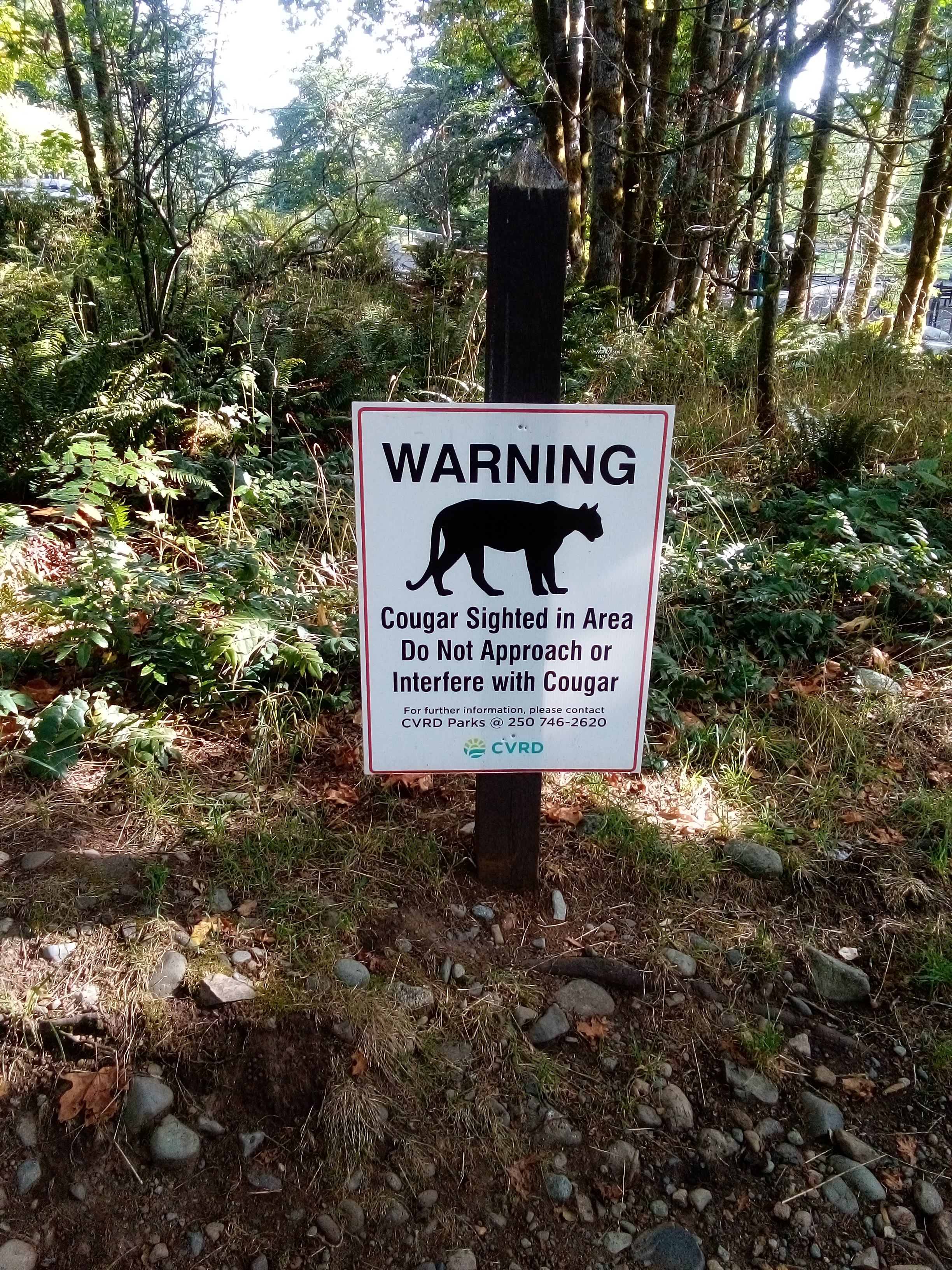
Did I mention the cougars?

Cougar sign

In This Together

Wounded Rain PictureWe started in the rain. We finished in the rain.

Port Hardy to Victoria in eight days. Over 600 kilometers of running.

One cause. Support our Wounded Warriors. Honour the fallen. Support the living.

Eight intense days. Fast running. Slow jogging. Gruelling hills, treacherous declines, glorious flatness.

Eight humbling days. Meeting heroes in Legions up and down the island. Veterans of long ago wars. Veterans who still wake at night reliving those horrors.

Eight days of overwhelmingly gracious receptions. Men, women and children flooding those Legions, and community centers. Preparing meals for us, wrapping their arms around us, digging deep in their pockets and thrusting cash in our hands.

Money to support the injured – our veterans, first responders and their families. Injuries caused by the horrific things so many of them have had to see and do. Trauma after trauma, experienced over and over, and imprinted on their minds.

Our team barely knew one another at the start of the run. By the end we were a family. We loved one another. We watched each fight through tough miles. We shared stories, laughs, and bathrooms. No secrets. No egos. No attitudes.

We succeeded as runners because of the people around us. Warriors themselves. They organized this run, drove us, fed us, clothed us, housed us and cared for us. Unconditionally. One big family.

In This Together. That mantra inspired our run. We repeated it a hundred times that week.

In this together. Those words have taken on a new meaning these last few days.

Our world is experiencing a crisis unlike anything most of us have ever lived through.

Daily life continues, and grinds to a halt simultaneously.

Our run squeaked in under the wire. Before mass cancelations and social distancing. Before we had to stop hugging and high fiving. Before a gathering of hundreds became life-threatening.

Life. That’s all that matters. Life and everything that goes with it. Physical health. Mental health. Love. Family. Community.

For weeks, maybe months, all our lives will change.

We’ll get through it. As a team. In this together.

Cathedral Grove WW

Wounded

We are all wounded. Physically. Mentally. Suffering is part of being human. But so is being there for one another.

I felt that every minute of every hour yesterday. I’m part of the Wounded Warriors Run team. In a couple weeks we’ll start at the top of Vancouver Island and run as a team to Victoria. Eight days, 600 kilometers.

Yesterday we started smaller. One day, and 58 K. A min-version of what is to come.

Our day, and my tears started in Sooke, BC. This small town, not far from Victoria is still grieving three young men killed in a terrible accident just over a week ago. An unthinkable, unfair tragedy.

We started at the Legion.   9:00 a.m. on a Sunday. Neither the time nor the day stopped veterans from donning their uniforms and their medals and greeting us with smiles and sustenance. This Legion exudes history. Grainy black and white photos of men who died overseas line the walls. I saw a bell forged from the metal of an aircraft shot down over England. I listened as the co-founder of this run prepared us for the physical and mental challenges to come, encouraging us to “find our moment.”

It didn’t take long for the moments to come. My tears started when “JZ,” our run director spoke, thanking our hosts. JZ is courageous and passionate and sincere. Our team would run through walls for her. The tears kept flowing when the Legion’s padre spoke about having joined the Legion in 1962 and having seen it evolve. In a different time and era, veterans drank and smoked and shared stories. They were there for one another. And now, Legions are community hubs. Open to everyone. A different time, a different era. The Legion there for the community. The community there for the Legion. Then the mayor spoke, and my tears continued, as she thanked Wounded Warriors for supporting the veterans who live in her community. After we marched outside, where the Legion has its own cenotaph – both simple and glorious, it has a magnificence beyond words. The Legion presented a cheque, over a thousand dollars raised in just the last few days. It wasn’t just a cheque. It was a message. We are all in this together.

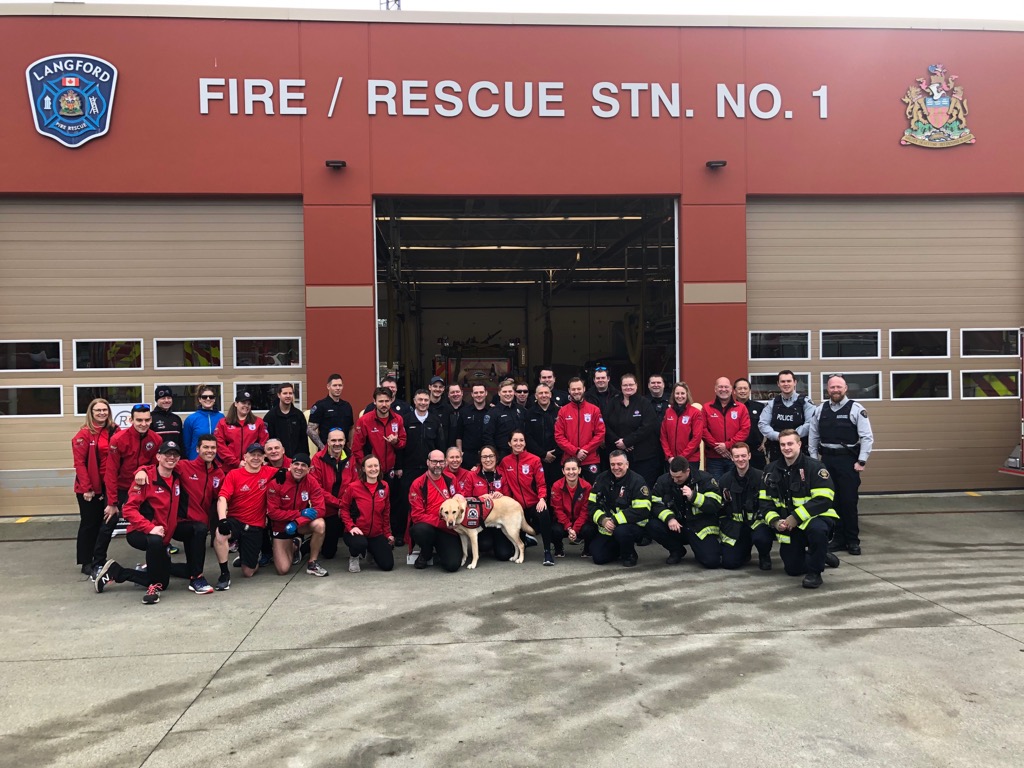
The run started relay fashion, our first runners hammering out fast miles on still slick roads, leading us to the Langford Fire Hall. The Fire Chief and Mayor greeted us. Both of them taking the time to be there, and speak, and tell their firefighters and our team that mental health matters. That the job can be very hard. That it takes a toll. And that Langford stands behind its first responders. And those first responders stood with our team. Inspiring us and feeding us. A hearty meal, cooked in a firehall kitchen. A meal to refuel our bodies. A meal with an unspoken message behind it. What’s ours is yours.

Our run continued, and an hour later our convoy pulled into the Saanich Police Department. The reception was extraordinary. An Honour Guard in full regalia lined the entranceway. An entranceway filled with Saanich cops – the Chief, Senior Officers, cops in uniforms, cops there on their day off. I saw a very dear friend who I had worked with for years. I hugged her and it felt great. We’d worked on very serious files together. Murder investigations. High pressure – high stakes. Intense files. We leaned on each other in the midst of those investigations. It was a great hug.

On the journey went, towards Sidney. Our team inspired by “Top Shape” an alumni member whose physical gifts and strength are matched only by his kindness and warm demeanour. Top Shape had run every leg so far, and just kept going. In total he ran over 50 k yesterday. Most of the rest of us did about 10. Pretty inspiring. So much so that “Top Shape” isn’t just his name. It’s a mantra the team uses for inspiration. “Top shape, top shape, top shape.”

My turn to run came with Top Shape and Maria. Maria is an RCMP member – the first Mountie in history to be part of the Wounded Warrior Run. Mounties do most of the policing in British Columbia. I have had the honour to work with many of them. Often, especially in the smaller detachments they are underfunded, understaffed, and overworked. Yet they push on, in the best tradition of that historical police force. They take care of their communities and they take care of each other. In it together.

The last two kilometers were the best. We ran in together as a team. Led by JZ. She wasn’t certain she’d be able to run yesterday. But she did. And lifted us all in the process.

We finished at the Sidney Fire Hall, stopping our run beneath a large Canadian flag which flew from the top of a towering ladder.

Inside the warmth and generosity continued. And the donations. Thousands of dollars from Serious Coffee and The Victoria Whiskey Festival. Multiples of thousands. From organizations that did not have to donate a cent. But did. Giving back to their communities. Humbling and sobering moments being part of a team which is a recipient of such generosity.

We are all wounded.

And we are all in this together.

Sidney Fire Hall


Pointless Acceleration

I wrote this earlier this year.  It came to mind today.  Christmas has been wonderful, yet often chaotic, and it often feels like there is no time to breath, much less read, write or run. ….  Merry Christmas everyone.  DB

POINTLESS ACCELERATION

I accelerated meters from the finish line. Pointless acceleration. I was already sprinting. This surge might buy me a few useless seconds. My goal was a sub 40 minute 10K. Twenty feet from the finish line my hamstring popped. My right hand clutched the back of my leg. I hobbled across the line, two minutes too slow.

It had been an ambitious target. Nine years earlier I’d run 39:55. Back then I was under forty, didn’t have a child, ran often, and had a coach.

This time around, I was close to fifty, had a young daughter, ran when I could, and followed a program I’d found online.

I trained hard. Many weekdays my alarm rang at 3:15 a.m. Cold runs, wet runs, dark runs. I ate a plant based whole food diet. Instead of two glasses of wine every night, I drank one glass weekly. I introduced intermittent fasting into my routine. By race day, I was twenty-five pounds lighter than I’d been at the start of training.

I didn’t train hard enough. I didn’t do enough speed work. Our neighbourhood is nothing but hills. Nothing is flat, nothing is fast. Instead I relied on a treadmill, where too much of the speed comes from the machine, and not enough from within.

Race day conditions were perfect. Cool, sunny, not too much wind. I went through 5K in 20:15. According to the clock, I had a chance. According to my body, it was already over. The last half of the race was a gigantic fade. Dozens of runners passed me. I did not pass anyone.

I trained too hard. I tore my hamstring at the finish line. The culmination of months of training, and a race run at maximum effort. I tried to squeeze out a tiny bit more speed. And a muscle rebelled and ripped. The next night, I woke up with a sore throat. Now, ten days later, I’m fighting a cold that will not go away. I slept thirteen hours last night, and still need to nap, while my nose and mouth compete to see which can expel the most phlegm.

One race, one injury, one cold. Blips in the life of a runner. But they feel like more than blips. They feel like a manifestation of inner turmoil and my inability to resolve the question, “Why do I run?”

I believe that hurting, suffering and sacrificing make me stronger. I believe that if I work hard enough, I can run faster in my fifties than I did in my thirties. The 10K was not a one-off. I envisioned it as the first of a series of challenges. A marathon or 50K in the fall. A 50 miler next year. And the year after that, months after turning 50, I’d try a 100 miler. Worthy goals.

And all of them taxing. On my time, on my family, and, increasingly I worry, on my health. I want to live a long and active life. I seek inner peace. Running can provide that on its own, without races, or personal bests, or ultra-distances. Without injuries and a compromised immune system. I could just run.

But I want it all. I want to show up, on the starting line, with the perfect balance of training and health. I want to cross the finish line experiencing both agony and accomplishment. I want to be ninety on my daughter’s 45th birthday. I want to run with her that day. I want to straddle the line of health and performance for a long, long time.